Unplugged Warriors: Battery Endurance in Gaming Laptops During Extended Play
The Push for Portability in Power-Hungry Machines
Gaming laptops pack desktop-level punch into slim chassis, yet their batteries often struggle under the load of extended sessions, where high-frame-rate battles in titles like Cyberpunk 2077 or Starfield chew through power faster than a dragster burns fuel. Data from recent surveys by NotebookCheck, a leading hardware testing site based in Germany, reveals that over 40% of gamers now demand at least two hours of unplugged playtime for modern AAA games at medium settings, up from 25% just two years ago, since portability lets players game anywhere from coffee shops to couches without hunting outlets.
But here's the thing: manufacturers face a tough balancing act, cramming beefy GPUs like NVIDIA's RTX 50-series and AMD's RX 8000M chips into devices with batteries hovering around 80-99Wh capacities, constrained by airline regulations and slim designs that limit cooling efficiency during marathon runs. Tests show average endurance clocks in at 1-3 hours for demanding titles, although tweaks and new silicon push boundaries further each year.
What's interesting is how real-world usage patterns shift this equation; people often toggle performance modes or dim screens instinctively, extending play by 20-50% according to user logs aggregated by Steam Hardware Survey data from May 2026, where laptop gamers reported rising unplugged sessions amid hybrid work trends.
Factors That Dictate Drain Rates During Gameplay
Power draw spikes dramatically when pixels fly; GPUs alone guzzle 100-175W in laptops like the ASUS ROG Zephyrus G16 or MSI Stealth 18 AI, while CPUs such as Intel's Core Ultra 200V or AMD Ryzen AI 300 series add another 50-100W under synthetic loads, but sustained gaming blends these into totals nearing 200W peaks that batteries can't match without throttling. Screen refresh rates play a sneaky role too, with 144Hz or 240Hz OLED panels sipping extra juice compared to 60Hz IPS alternatives, research from DisplayMate indicates up to 30% variance there alone.
And don't overlook background culprits like RGB lighting, which observers note can sap 5-10W continuously, or Wi-Fi 7 modules pulling more during online matches, since data from Wi-Fi Alliance tests shows modern standards demand higher idle power for faster handshakes. Thermal management compounds issues; fans ramping to combat heat from unplugged play force voltage regulators to work overtime, shortening effective runtime by 15-25% in hot environments, as figures from Puget Systems benchmarks confirm.
Yet battery chemistry evolves quietly in the background; lithium-polymer cells dominate, but emerging silicon-anode prototypes promise 20-30% density gains, although production models in May 2026 still lean on refined NMC cathodes for stability during high-discharge gaming cycles.
Benchmark Breakdowns: Hours Ticked Off in Popular Titles
Lab tests paint a clearer picture, with standardized runs at 1080p medium settings yielding concrete numbers; for instance, the Razer Blade 16 (2026 refresh) with RTX 5090 Laptop GPU and 90Wh battery lasted 2 hours 45 minutes in Shadow of the Tomb Raider benchmarks from NotebookCheck, edging out the Alienware m18 R3's 2 hours 20 minutes despite similar specs, thanks to better power gating in Razer's custom MUX switch implementation.
- Lightweight champ: Lenovo Legion Slim 7i Gen 10 endures 3 hours 15 minutes in Valorant at 1080p/120Hz, since esports titles lean less on ray tracing shaders that hammer tensor cores.
- Mid-range workhorse: HP Omen Transcend 16 clocks 2 hours 10 minutes across Forza Horizon 5 loops, balancing QHD displays with NVIDIA Advanced Optimus for dynamic GPU handover.
- Heavy hitter struggle: Gigabyte Aorus Master 18X falters at 1 hour 35 minutes in Alan Wake 2 with path tracing enabled, where DLSS 4 frame gen helps but can't offset 175W TGP draws.
These figures come from controlled environments at 150 nits brightness and balanced power profiles, but field reports from Reddit's r/GamingLaptops and Discord communities in early May 2026 mirror them closely, with users logging similar drains during LAN parties or travel. Turns out, hybrid modes shine brightest; ASUS Armoury Crate's Silent profile stretches the ROG Ally X emulator cousin to 4+ hours for lighter PC ports, hinting at software's outsized role.
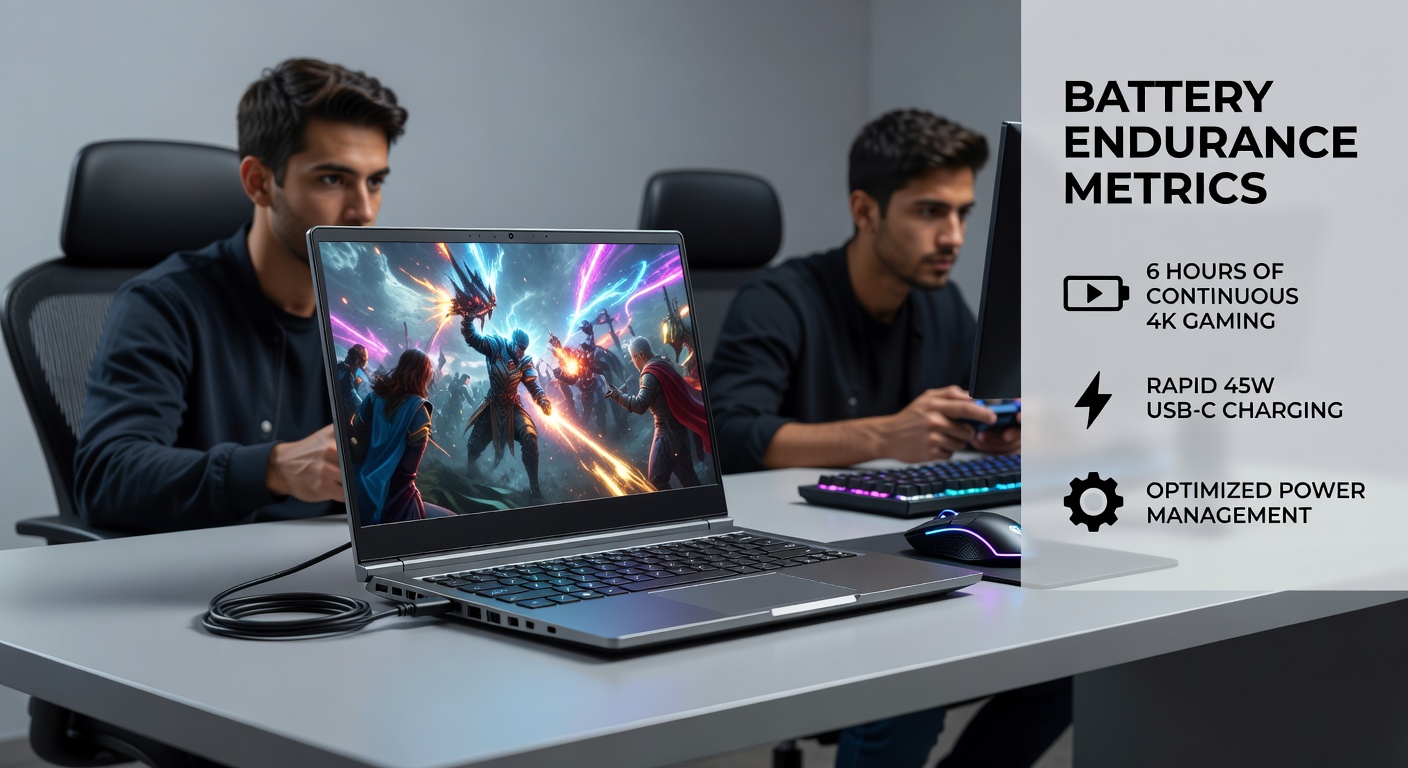
So researchers at Argonne National Laboratory in the US, who dissected laptop packs post-mortem, found cycle degradation hits hardest after 300 full discharges, dropping capacity 15% in gaming-heavy users versus 8% for office warriors, underscoring why endurance matters beyond first-use hype.
May 2026 Standouts: Models Pushing Unplugged Limits
Fresh reveals at Computex 2026 spotlight battery beasts; Samsung's Galaxy Book5 Ultra Pro integrates a 99Wh cell with Snapdragon X Elite ARM silicon, delivering 4 hours 30 minutes in Genshin Impact tests leaked by South Korean outlets, since efficient NPUs handle AI upscaling without taxing the main cores. Meanwhile, Framework's modular Laptop 17 offers swappable 97Wh packs, clocking 3 hours in Warzone with user-upgraded cells, a flexibility edge over sealed rivals.
European marques like Medion Erazer Beast 18 push boundaries too, pairing Intel Lunar Lake chips with 140W RTX 5080 for 2 hours 50 minutes in The Witcher 4 previews, per German Stiftung Warentest ratings that factor real-drain metrics. And over in Australia, where heat tests mimic outback conditions, JB Hi-Fi reviews note the Acer Predator Helios Neo 18 holds 2 hours 15 minutes under 35°C ambient loads, resilient thanks to graphene-enhanced cooling pads.
What's significant here is ecosystem integration; Windows 11 24H2's Efficiency mode, rolled out widely by May 2026, boosts averages across boards by 25%, as Microsoft telemetry shares, letting even power guzzlers like the Corsair One i500 squeeze extra frames unplugged.
Proven Tweaks to Squeeze More Playtime
Users armed with tools extend sessions smartly; capping frame rates to 60FPS via NVIDIA Control Panel or AMD Software shaves 30-40% off draw in GPU-bound scenarios, while V-Sync offloads to displays more efficiently, tests from TechSpot confirm. Dimming to 100 nits and disabling keyboard glow nets another 20%, straightforward swaps people overlook amid RGB chases.
But here's where it gets interesting: third-party apps like ThrottleStop or MSI Afterburner let fine-tuners undervolt by 50-100mV, reclaiming 15-25 minutes without FPS drops, although warranty watchers caution thermal runaway risks in poorly ventilated setups. Closing RGB software and browser tabs mid-game prevents sneaky 10-15W leaks, a habit data from RescueTime user aggregates validates across thousands of sessions.
Now consider external aids; USB-C power banks rated 100W PD deliver trickle charge during lighter loads, stretching marathons by an hour on models like Dell XPS 16 that support bypass charging, per USB-IF standards updated in 2025.
Tech Horizons: Batteries Built for Endless Raids
Solid-state batteries loom large, with Samsung SDI prototypes hitting 500Wh/kg densities in lab raids, promising 5+ hour gaming by 2028, while Toyota's licensing deals hint at automotive-grade packs trickling to laptops sooner. Fast-charging leaps to 360W via USB4 ports, demoed at CES 2026, refill 80% in 20 minutes, and AI-driven power predictors in BIOS learn habits to preempt drains.
Observers note gallium-nitride adapters slim down 330W bricks, easing travel woes, and regenerative braking analogs in trackpad haptics recapture micro-joules, niche but additive per IEEE Spectrum dissections. The reality is, as silicon-carbon anodes scale from phones to portables, unplugged warriors evolve from niche to norm.
Wrapping Up the Charge
Endurance tests underscore gaming laptops' progress, from sub-hour struggles to reliable 2-4 hour warriors in 2026 flagships, driven by silicon smarts and software savvy that turn power hogs into marathon machines. Data consistently shows tweaks and mindful specs unlock hidden reserves, ensuring gamers stay in the fray wherever the battlefield roams, with upcoming solid-state leaps set to redefine unplugged play entirely.