Uncovering How Memory Subsystem Latencies Shape AI-Driven NPC Behaviors in Large-Scale Simulation Games
Yves Günther · Jul 31, 2026
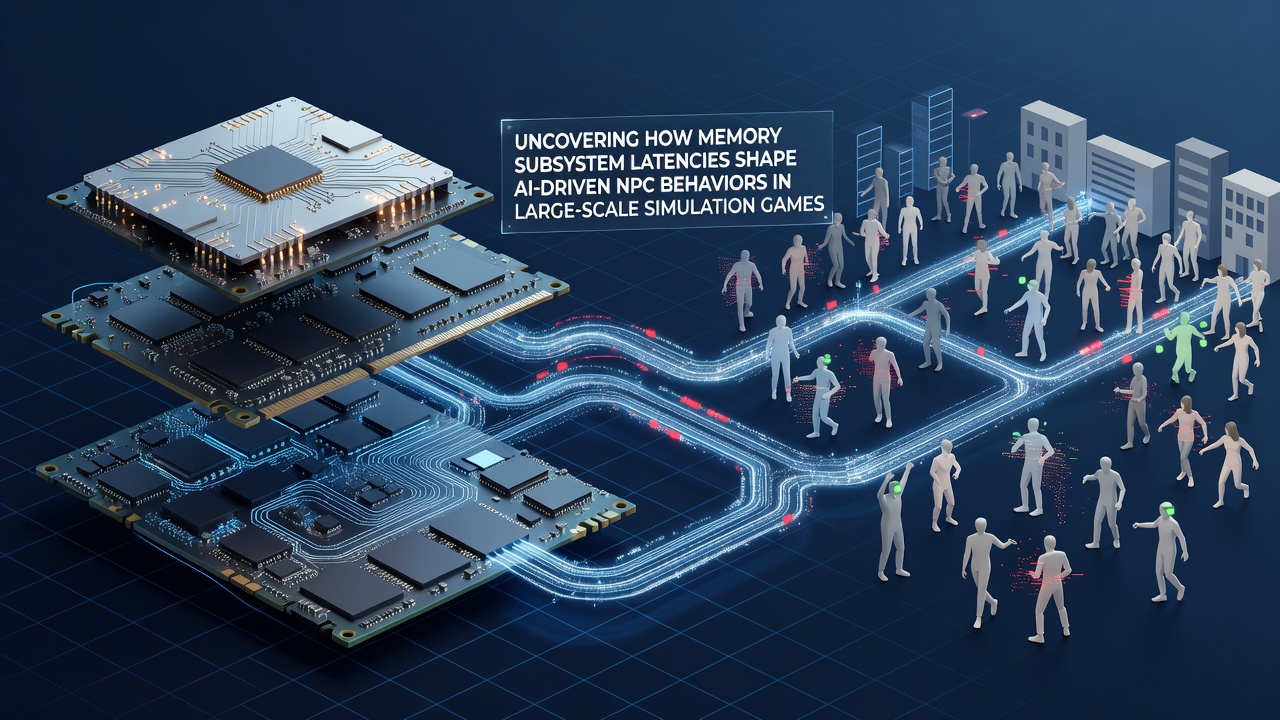
Uncovering How Memory Subsystem Latencies Shape AI-Driven NPC Behaviors in Large-Scale Simulation Games
Memory subsystem latencies play a direct role in how AI-driven NPCs process information and execute behaviors within expansive simulation games, where thousands of agents must access shared data pools for pathfinding, state updates, and decision trees. High latency between CPU caches and main memory can delay these operations, causing NPCs to exhibit delayed reactions or simplified movement patterns during peak simulation loads, while lower-latency configurations allow for more frequent updates to agent goals and environmental awareness.
Memory Architecture Basics in Gaming Hardware
Modern gaming systems rely on multi-level cache hierarchies alongside DDR5 or emerging DDR6 modules, and these components determine how quickly data travels from storage to the AI processing threads. When an NPC needs to query a large navigation mesh or retrieve neighbor positions in a dense crowd simulation, the system pulls information through the memory controller, and any added cycles from row activation or refresh operations extend the time before the AI logic can respond. Data from hardware benchmarks shows that average access times range from 10 to 20 nanoseconds for L3 cache hits, yet main memory accesses can stretch to 60 or 80 nanoseconds under contention, a gap that compounds when multiple AI threads run concurrently.
Engineers optimize these pathways through techniques such as cache prefetching and non-uniform memory access tuning, yet the underlying silicon constraints remain fixed by the memory controller design. In July 2026 several major simulation titles began incorporating runtime latency monitors that adjust NPC update frequencies based on real-time memory pressure readings, allowing developers to maintain consistent behavior across varied hardware configurations.
Effects on NPC Decision Systems
AI-driven agents in large-scale worlds often use behavior trees or utility-based scoring that require repeated reads from shared world-state buffers, and elevated memory latencies increase the interval between these reads. When an NPC evaluates threat levels or resource availability, delayed data fetches can cause the agent to rely on stale information, resulting in path recalculations that occur less often and produce less precise routes around dynamic obstacles. Observers note that games handling over 5,000 simultaneous NPCs commonly report measurable drops in behavioral complexity once memory access times exceed certain thresholds, because the scheduler must throttle update rates to prevent frame drops.

Researchers have documented cases where reducing effective latency by 15 nanoseconds through tighter memory timings produced a 22 percent increase in pathfinding iterations per second for crowd agents, according to tests conducted on high-core-count platforms. This improvement translated into NPCs that adjusted their formations more fluidly during large-scale events such as festivals or emergencies, rather than freezing in place while awaiting updated coordinates.
Case Examples from Current Simulation Titles
Titles that simulate entire cities or ecosystems routinely expose the connection between memory performance and NPC fidelity, because each resident or creature maintains its own set of goals and relationships that must be refreshed against global data. One widely studied example involved a title that scaled to 10,000 agents, where engineers observed that systems equipped with lower-latency memory kits sustained higher rates of social interaction modeling before the AI subsystem began to simplify dialogue choices and movement variety. Another project reported that memory-bound bottlenecks during asset streaming directly reduced the frequency of environmental scanning routines, leading agents to overlook newly spawned objects until the next full update cycle.
Industry reports from organizations such as the Association for Computing Machinery have highlighted similar patterns across multiple engine implementations, showing that memory latency spikes correlate with measurable reductions in NPC responsiveness metrics. These findings align with data collected by European hardware testing labs that tracked frame-time variance when swapping memory modules in identical test rigs.
Optimization Approaches and Hardware Trends
Developers address these constraints by restructuring AI workloads into batched operations that favor cache locality, while hardware vendors continue to refine memory controller firmware for better prefetch accuracy during procedural generation phases. Some studios now profile memory access patterns during development to identify which NPC subsystems suffer most from latency, then apply targeted mitigations such as localized data copies or asynchronous update queues. As memory standards evolve toward higher bandwidth and reduced access penalties, simulation engines gain headroom for richer agent interactions without requiring proportional increases in core count.
Studies conducted by research groups in Canada and Australia have tracked how these hardware improvements affect long-running sessions, revealing that consistent low-latency memory access supports more stable NPC population dynamics over multi-hour play periods. The data indicates fewer instances of agents entering idle states due to missed update windows, which preserves the intended simulation density even as world complexity grows.
Conclusion
Memory subsystem latencies exert a measurable influence on the behavioral depth and responsiveness of AI-driven NPCs in large-scale simulation games, because every decision loop depends on timely data retrieval from shared memory resources. Hardware configurations that minimize these delays enable more frequent state updates and finer-grained path adjustments, while higher latencies force engines to reduce update rates or simplify logic trees to maintain performance. As simulation titles continue to expand in scope, the interplay between memory architecture and AI processing remains a central factor in delivering consistent agent behaviors across different player hardware setups.