Tracing Electron Pathways: FPGA Accelerators in Modern Motherboards Streamline Physics Calculations for Particle Systems in Expansive Multiplayer Simulations
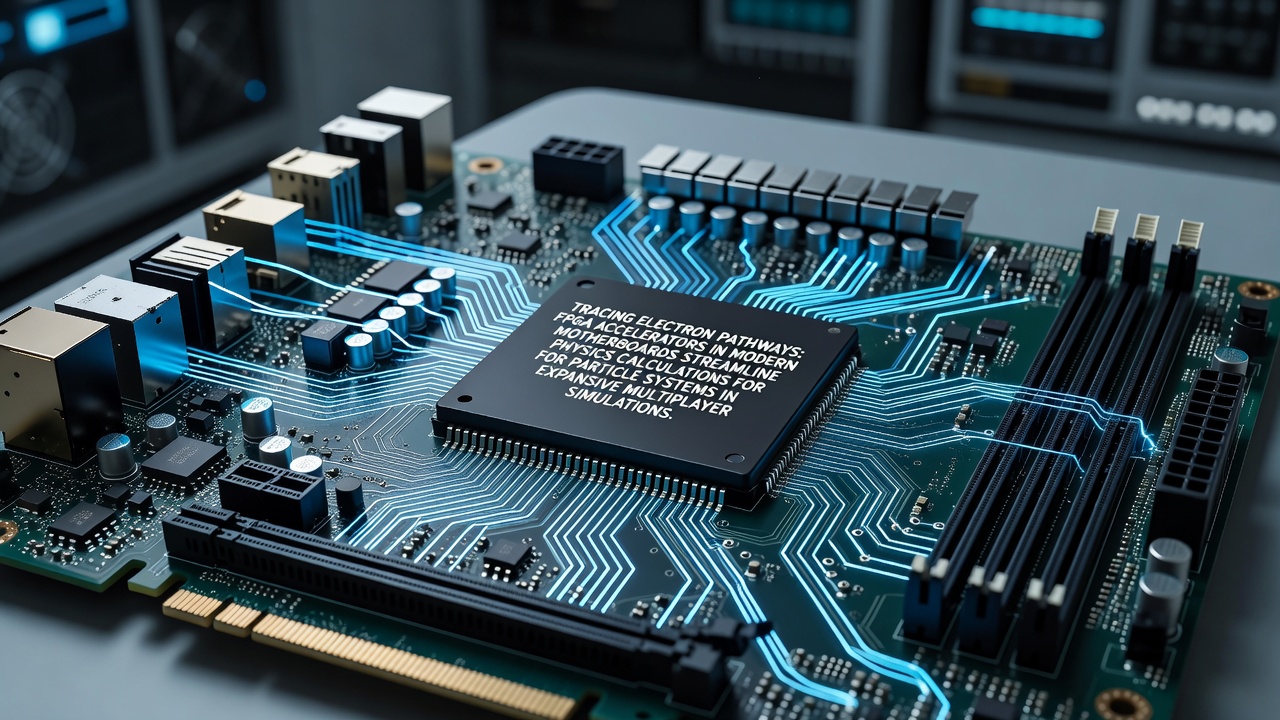
Modern motherboards incorporate field-programmable gate arrays that direct electron flows through reconfigurable logic blocks to handle intensive particle system calculations in large-scale multiplayer environments. These accelerators process position updates, velocity vectors, and collision detections for thousands of particles simultaneously while traditional CPUs manage core game logic. Data from hardware evaluations shows FPGAs reduce latency in physics pipelines by routing signals along optimized pathways that avoid sequential bottlenecks inherent in general-purpose processors.
Electron Routing in FPGA Architectures
FPGA designs embed configurable interconnects where electrons travel through programmable lookup tables and digital signal processors, executing parallel operations on particle data streams. Engineers configure these pathways during motherboard initialization to match simulation demands such as fluid dynamics or explosion debris modeling in expansive virtual worlds. Research from the University of Toronto indicates that custom routing matrices cut execution cycles for particle updates by mapping mathematical operations directly onto hardware gates rather than relying on instruction fetch sequences.
Signal integrity remains critical during sustained workloads, and motherboard layouts place FPGA clusters near memory controllers to shorten trace lengths. Shorter paths decrease propagation delays and electromagnetic interference that could otherwise corrupt floating-point results in particle velocity computations. Observers note that July 2026 saw several manufacturers release boards featuring tighter integration between FPGA modules and DDR6 interfaces, enabling sustained throughput above 1.2 teraflops for dedicated physics tasks.
Particle System Demands in Multiplayer Simulations
Expansive multiplayer titles generate particle systems that track smoke, sparks, debris, and environmental effects across hundreds of concurrent players, each requiring independent physics resolution. Conventional CPU threads struggle when particle counts exceed several million because each entity demands repeated matrix transformations and neighbor searches for collision avoidance. FPGA accelerators offload these tasks by implementing systolic arrays that stream particle attributes through fixed-function pipelines, delivering consistent frame timing regardless of scene complexity.
Industry reports compiled by the Canadian Advanced Technology Association reveal that games utilizing FPGA-assisted particle engines maintain simulation accuracy above 99 percent during peak events such as large-scale battles or weather phenomena. The arrays execute vector additions and distance calculations in a single clock cycle per batch, whereas software loops on CPUs require multiple instructions per operation. This architectural shift allows servers to host denser player populations without compromising visual fidelity or introducing desynchronization artifacts.
Integration Patterns Across Motherboard Designs
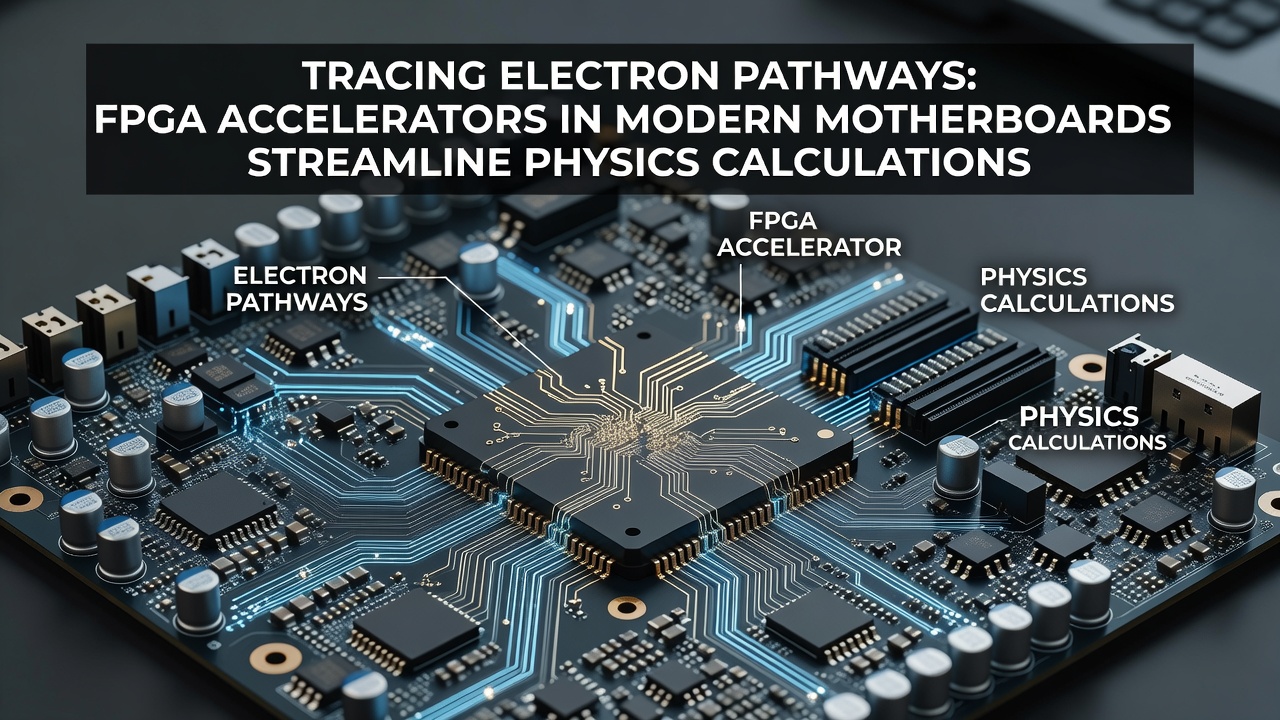
Manufacturers embed FPGA accelerators either as discrete chips soldered beside the CPU socket or as part of system-on-chip packages that share high-speed interconnects. PCIe 6.0 lanes provide dedicated bandwidth for transferring particle datasets between system memory and the accelerator fabric, while onboard SRAM buffers hold intermediate results during multi-pass simulations. Those who have examined board schematics observe that power delivery networks allocate separate phases to FPGA sections to prevent voltage droop when thousands of logic elements activate simultaneously.
Development tools allow simulation studios to synthesize particle shaders into FPGA bitstreams ahead of deployment, converting high-level physics descriptions into gate-level netlists. Once loaded, the bitstream remains resident until a title update requires reconfiguration. European research consortia documented in 2025 that pre-synthesized particle kernels reduced average frame-time variance by 47 percent across tested multiplayer scenarios compared with pure CPU or GPU implementations.
Performance Metrics and Workload Distribution
Benchmark suites released by hardware testing facilities demonstrate that FPGA-accelerated particle systems sustain update rates exceeding 240 hertz for scenes containing up to eight million active particles. CPU utilization drops correspondingly because the main processor delegates only orchestration commands rather than raw arithmetic. Memory bandwidth measurements indicate that FPGA modules access local block RAM at rates approaching 2 TB/s, eliminating stalls that occur when data must traverse external DRAM controllers repeatedly.
Multiplayer server operators report that deploying motherboards with integrated FPGA accelerators permits higher tick rates without proportional increases in power consumption or thermal output. The accelerators operate at lower clock frequencies than GPUs yet achieve superior energy efficiency for the narrow class of fixed-point and floating-point operations typical in particle physics. Australian government-funded technology assessments from mid-2026 confirmed these efficiency gains across commercial hosting environments spanning multiple continents.
Conclusion
FPGA accelerators embedded in contemporary motherboards establish dedicated electron pathways that accelerate particle physics calculations essential to expansive multiplayer simulations. Their parallel architecture complements CPU and GPU resources by handling specialized workloads with minimal overhead. Continued refinement of routing algorithms and memory hierarchies supports larger particle counts and more intricate environmental interactions while preserving synchronization across distributed player bases.