Silicon Weave Patterns Shape Signal Paths in Enthusiast Motherboards
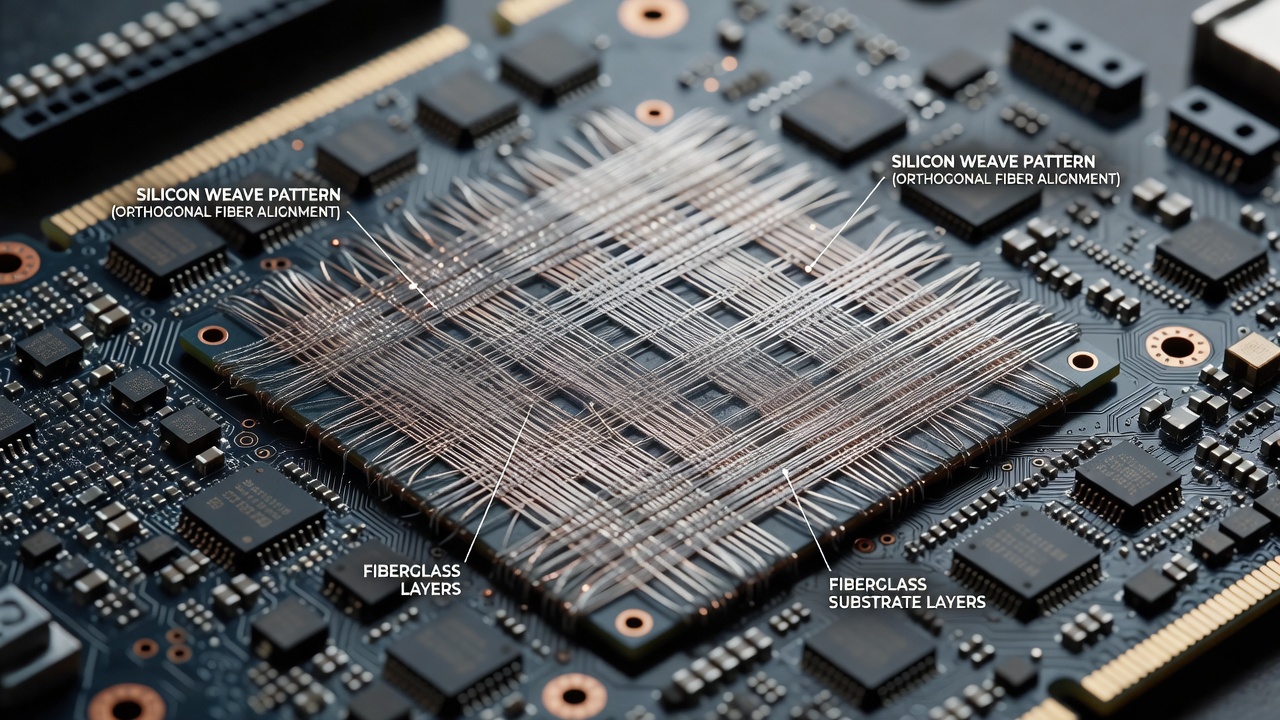
Enthusiast motherboards rely on precisely aligned fiberglass substrates to maintain electrical performance when memory modules run at elevated frequencies, and these patterns become especially relevant during overclocking sessions that support demanding simulation workloads in strategy titles.
Fiberglass Substrates Form the Foundation
Manufacturers construct printed circuit boards using woven fiberglass cloth impregnated with epoxy resin, and the orientation of those fibers determines how electrical signals travel across traces without excessive interference or loss. Data from industry testing shows that random fiber orientations can introduce impedance variations, whereas controlled weave alignments reduce such fluctuations during high-speed operations. Researchers at institutions across North America and Europe have documented how substrate consistency affects trace capacitance and inductance, factors that grow critical once memory speeds exceed standard specifications.
Silicon Weave Patterns and Their Alignment
Silicon weave patterns refer to the microscopic arrangement of glass fibers within the substrate layers, and engineers adjust these alignments during the lamination process to create predictable pathways for differential signaling. When fibers run parallel or at calculated angles to the trace directions, signal propagation remains more uniform, which helps preserve timing margins in memory channels. Figures from materials science reports indicate that optimized weave densities can lower dielectric losses by measurable percentages, allowing boards to sustain stable operation even when voltages and frequencies increase beyond stock limits.
Signal Integrity Under Extreme Memory Overclocks
Memory overclocking pushes DRAM modules to transfer data at rates far above JEDEC standards, and this places direct demands on the motherboard's ability to deliver clean clock and data signals. Aligned fiberglass substrates help minimize crosstalk between adjacent traces and reduce reflections that would otherwise corrupt bits during intensive read-write cycles. Observers note that boards featuring tighter weave controls often exhibit lower error rates in stress tests conducted at frequencies above 8000 MT/s, conditions frequently encountered in simulation-heavy strategy environments where large datasets move continuously between system memory and processor caches.
Applications in Simulation-Heavy Strategy Titles
Games that model complex economies, unit behaviors, and environmental interactions place sustained loads on memory subsystems, and these workloads expose any weaknesses in signal transmission paths. Motherboards with refined substrate alignments support the higher memory throughputs required for smooth handling of thousands of simultaneous calculations without introducing latency spikes or data corruption. Performance logs from multiple hardware evaluations reveal that systems equipped with such boards maintain frame consistency longer during extended play sessions compared with boards using standard weave configurations.
Developments Observed Through June 2026
By June 2026, several motherboard vendors had incorporated advanced fiberglass alignment techniques into their flagship models, responding to demand from users running memory kits at extreme settings. Reports compiled by research groups in Australia and the European Union highlight incremental improvements in trace impedance matching achieved through automated optical inspection during manufacturing. These refinements appear in boards designed for both Intel and AMD platforms, where memory controllers operate at higher baseline speeds and benefit from reduced substrate-induced jitter.
Testing protocols now routinely include multi-hour overclock validation runs that replicate the memory access patterns found in large-scale strategy simulations. Such tests confirm that weave-optimized boards sustain signal eye openings within acceptable limits even after prolonged exposure to elevated temperatures and voltages.
Conclusion
Substrate weave patterns represent a foundational yet often overlooked element in motherboard design, and their influence on signal integrity becomes measurable when memory operates beyond conventional limits in compute-intensive gaming scenarios. Continued refinement of fiberglass alignment processes supports the performance requirements of modern strategy titles while maintaining electrical stability across enthusiast hardware configurations.