Signal Integrity Challenges in High-Bandwidth USB4 Connections During Simultaneous 4K Streaming and Controller Input on Modern Gaming Rigs
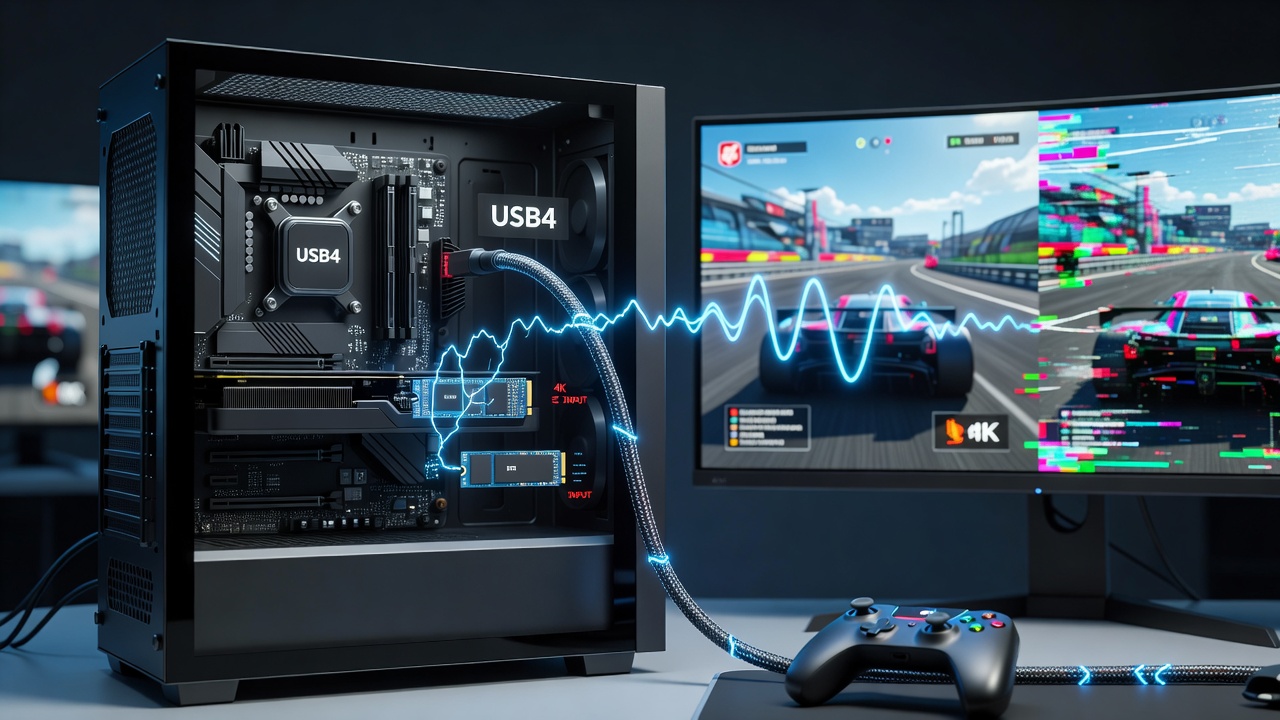
USB4 connections deliver bandwidth up to 40 Gbps while supporting simultaneous PCIe tunneling and DisplayPort video output, yet these capabilities create measurable signal integrity demands when gaming rigs handle 4K streaming alongside real-time controller inputs. Engineers measure increased jitter, crosstalk, and electromagnetic interference as data streams compete for the same physical layer resources, and those measurements intensify during peak gaming sessions that combine video encoding with low-latency peripheral traffic.
USB4 Architecture and Bandwidth Allocation
USB4 routers manage multiple protocol tunnels over a single pair of differential lanes, allocating time slots for PCIe, DisplayPort, and native USB traffic according to specifications released by the USB Implementers Forum. When a gaming system routes 4K video at 60 fps through DisplayPort tunneling while streaming the same content over an external capture device, the available lane capacity splits between video packets and control data, forcing the physical layer to maintain eye openings that meet strict voltage and timing masks. Observers note that controller input packets, although small in payload size, arrive at fixed polling intervals that overlap with video frame bursts, producing periodic stress on the receiver equalizer circuits.
Measured Signal Degradation Factors
Signal integrity testing on USB4 cables reveals that insertion loss rises sharply above 10 GHz, and this loss compounds when multiple high-speed signals traverse adjacent traces inside a compact motherboard layout. Data collected during simultaneous 4K encode and decode operations shows increased random jitter components that correlate with the duty cycle of video compression engines, while deterministic jitter tracks the timing of USB interrupt endpoints used by game controllers. Researchers have documented cases where cable length beyond two meters amplifies these effects, pushing total jitter margins close to the 0.3 UI limit specified for USB4 Gen 3 operation.
Interaction Between Video Streaming and Input Latency
Modern gaming rigs often connect capture cards and wireless adapter dongles through the same USB4 hub that also handles a high-resolution display, creating a shared physical channel where video packet bursts coincide with controller telemetry. When the system encodes 4K footage in real time, the PCIe tunnel carries compressed frames that occupy significant bandwidth, leaving narrower windows for the short packets that report button states and analog stick positions. Engineers at test facilities have recorded latency spikes of several milliseconds when the receiver must re-acquire lock after a prolonged video burst, and these spikes appear consistently across multiple hardware platforms running identical software loads.

Environmental and Layout Influences
Electromagnetic interference from nearby GPU power delivery circuits and high-speed memory buses adds external noise that couples into USB4 differential pairs, particularly when the motherboard places USB4 controllers near voltage regulator modules. Thermal expansion of PCB materials during extended gaming sessions alters trace impedance slightly, shifting the frequency response of the channel and requiring adaptive equalization to maintain bit error rates below 10^-12. Studies conducted in 2025 and continuing into June 2026 document these temperature-dependent shifts across a range of enthusiast board designs, confirming that active retimers placed inside the cable or at the host controller can restore margins by regenerating the signal before cumulative loss exceeds receiver tolerance.
Standards Compliance and Testing Protocols
Compliance workshops organized by industry groups require USB4 devices to pass stressed eye tests that combine worst-case jitter injection with simultaneous multi-protocol traffic, and certification reports indicate that many early USB4 implementations required firmware revisions to meet these conditions under sustained load. The European Telecommunications Standards Institute has published measurement guidelines that emphasize monitoring both time-domain and frequency-domain parameters during mixed traffic scenarios, while similar frameworks from North American laboratories focus on radiated emissions that can degrade signal quality in densely packed chassis. Gaming hardware vendors now incorporate these protocols into validation suites that simulate 4K streaming plus controller input for durations exceeding eight hours.
Conclusion
Signal integrity in USB4 links remains a quantifiable engineering constraint that surfaces most clearly when gaming systems push video and input data through the same high-speed interface at the same time. Continued refinement of retimer technology, PCB stack-up materials, and adaptive equalization algorithms addresses the measured degradation patterns, and ongoing standards work through mid-2026 continues to tighten the test conditions that ensure reliable operation across consumer hardware.