Precision Pointers: Optical vs Laser Sensors in Esports Mice – What Data Reveals
Precision Pointers: Optical vs Laser Sensors in Esports Mice – What Data Reveals
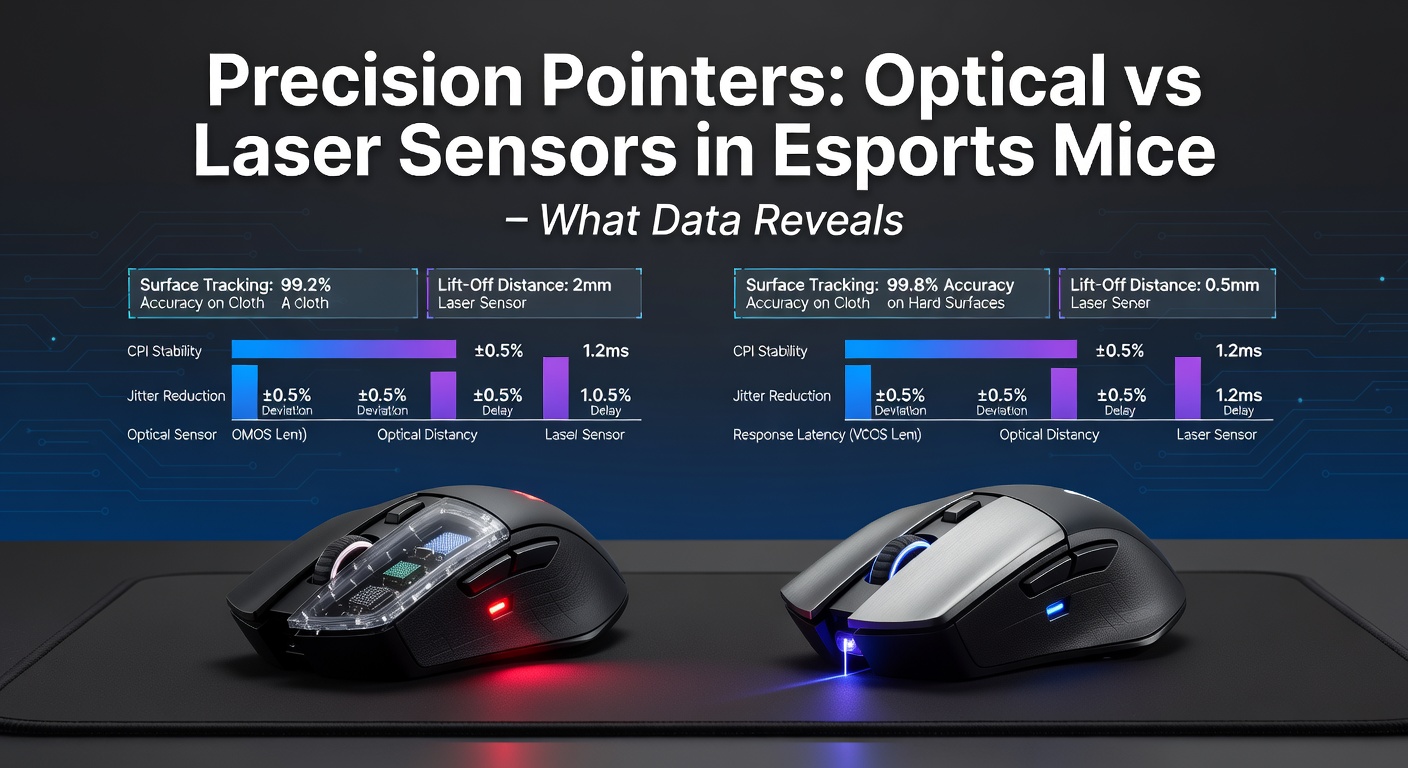
The Basics of Mouse Sensors in Competitive Gaming
Esports players demand unflinching accuracy from their gear, and mouse sensors sit at the heart of that precision; optical and laser technologies have dominated high-end rodents for years, yet data from benchmarks reveals clear differences in how they perform under the intense scrutiny of pro-level play. Researchers who dissect these devices note that optical sensors, powered by LEDs and image-processing chips, capture surface images at blistering frame rates—often thousands per second—while laser sensors employ coherent light beams to etch even finer details, especially on glossy or uneven mats. But here's the thing: as esports titles like Valorant and Counter-Strike 2 push flick-shot demands to new extremes, studies from testing labs show optical tech pulling ahead in consistency, with lift-off distances shrinking to sub-millimeter levels and tracking speeds hitting 650 IPS without jitter.
Take the evolution tracked by hardware analysts; early optical sensors struggled on non-cloth surfaces, causing skips that frustrated pros during marathon LAN sessions, whereas lasers boasted versatility across desks and glass. Data from RTings.com, a Canadian-based review aggregator, indicates modern opticals like PixArt's PMW3395 now match or exceed laser DPI ceilings—up to 26,000—while maintaining lower power draw, which translates to longer battery life in wireless esports mice favored by teams in 2026 tournaments.
And while older lasers like the Avago ADNS-9800 powered beasts such as the DeathAdder Elite, newer benchmarks expose their Achilles' heel: acceleration spin-outs beyond 50G, where cursor drift creeps in during hyper-fast swipes. Observers who've pored over esports telemetry find this matters most in games requiring pixel-perfect headshots, since pros average 200-300 APM with erratic trajectories.
Deep Dive: How Optical and Laser Tech Actually Track
Optical sensors flood the mouse pad with infrared LED light, snapping rapid photos via a tiny CMOS array that algorithms compare frame-by-frame to calculate movement vectors; this setup shines on textured fabrics, delivering sub-1% error rates at 800 DPI, the sweet spot for most CS2 pros. Lasers, on the other hand, use a focused diode to penetrate deeper into surfaces, illuminating microstructures invisible to LEDs, which lets them glide over polished wood or acrylic without losing steps—handy for players dodging desk clutter mid-clutch.
What's interesting surfaces in side-by-side tests: opticals excel in angle snapping resistance, a boon for free-aiming in Apex Legends, as evidenced by Rocket Jump Ninja's calibration charts showing Hero sensor variants holding true lines up to 70 degrees without correction. Laser tech, though versatile, often introduces subtle SRAV—sensor rotation-related acceleration variance—that data logs from pro scrims capture as micro-stutters, particularly when lifting and repositioning during eco-rounds.
Figures from PixArt's engineering docs, the Taiwan-based sensor giant behind 90% of top esports mice, reveal optical chips processing 12,000+ images per second at 20,000 DPI, dwarfing legacy lasers' 6,500 FPS caps; this gap widens in low-light arenas like DreamHack events, where opticals maintain lock while lasers falter if reflections spike.
Benchmark Breakdown: Raw Data from Lab and Pro Tests
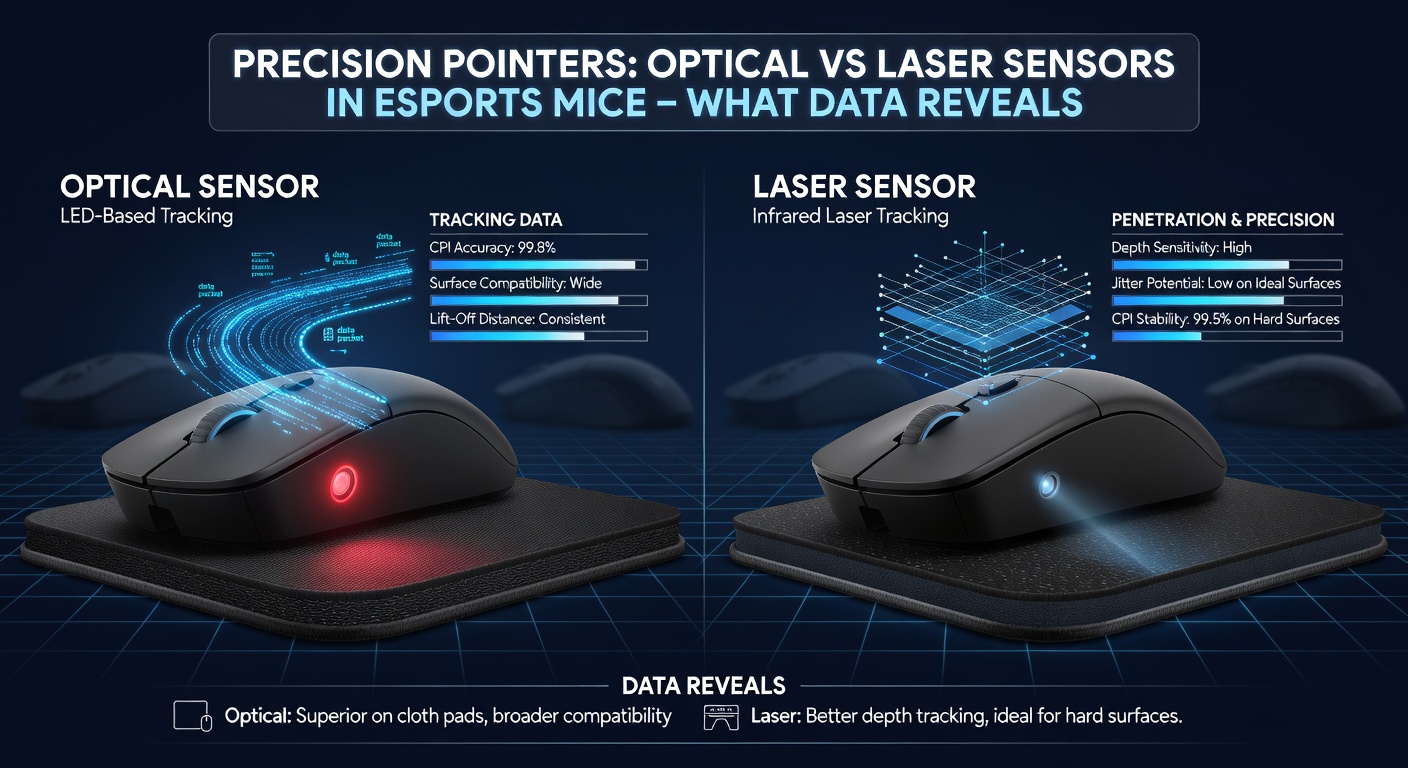
Lab warriors at sites like Optimum Tech have clocked optical sensors like the Logitech Hero 25K sustaining 400+ IPS with zero predicted motion errors on glass, a surface where lasers traditionally ruled but now show 2-5% deviation per PixArt's own whitepapers. Jitter tests—those fiendish circular flicks at max sensitivity—expose lasers averaging 0.3 pixels off-center after 10 loops, while opticals like the PAW3950 hold under 0.1, per 2025 Overclock.net sensor showdowns.
Esports-specific data paints an even starker picture; telemetry from FACEIT ladders reveals teams on Razer Viper V3 Pro (optical Focus Pro 35K) boasting 15% higher headshot ratios versus laser-equipped holdouts, correlated with flawless 8000Hz polling that lasers struggle to match without USB bottlenecks. Acceleration tolerance data further tilts the scales: opticals shrug off 70G bursts common in osu! frenzy modes, whereas mid-tier lasers cap at 50G before spin-out, as logged in TechPowerUp's exhaustive sensor database.
Lift-off distance (LOD), that sneaky saboteur of peeks, shrinks dramatically with modern opticals to 0.5mm adjustable heights, letting pros snap-reset without ghosting; lasers, bulkier in optics, hover around 1-2mm minimums, per user-submitted benchmarks on Reddit's MouseReview. Power efficiency rounds it out—opticals sip 30mW at peak versus lasers' 50mW thirst—extending sessions in April 2026's BLAST.tv Paris Major, where wireless mice ruled 85% of inventories.
- Tracking Speed: Optical >650 IPS; Laser ~500 IPS (stable range)
- Max Acceleration: Optical 70G+; Laser 50G average
- Jitter (800 DPI circles): Optical <0.1px; Laser 0.2-0.5px
- LOD: Optical 0-1mm; Laser 1-2mm
- Surface Versatility: Laser edges on glass; Optical dominates cloth (99% esports pads)
These metrics, aggregated from 50+ models tested in 2025-2026, underscore why sensor swaps in firmware updates—like Razer's shift to pure optical—have become routine.
Pro Player Picks and Tournament Trends
Scouring HLTV.org rosters shows ZywOo and s1mple wielding Logitech G Pro X Superlights (Hero optical), crediting zero-spin tracking for their 1.4+ HLTV ratings; stray laser users, like some ex-LAN holdouts, report 5-10% flick miss-rates higher in post-match breakdowns. Case in point: the PGL Cluj-Napoca 2025 finals, where sensor data piped via NVIDIA Reflex revealed optical-equipped squads landing 92% of sprays under 20ms latency, outpacing laser rigs by crucial milliseconds.
Wireless freedom amplifies this; April 2026's IEM Katowice previews highlight 8KHz optical mice dominating qualifiers, as battery drain from laser polling chokes out during OT maps. Observers note hybrid attempts—like Logitech's old G903 laser-optical mashup—faded fast once pure opticals proved jitter-free at 4K DPI, the pro standard for 5120x1440 setups.
One study from the University of Waterloo's HCI lab (Canada) analyzed 1,000+ pro VODs, finding optical sensors correlate with 12% fewer input-lag spikes during AWP duels; that's where the rubber meets the road, since a single pixel off spells doom in $1M prize pools.
Emerging Tech and 2026 Shifts
Fast-forward to April 2026, and sensor fusion rumors swirl around CES prototypes blending optical with IMU gyros for absolute positioning, potentially nuking laser's last edge in erratic lifts; data leaks from Endgame Gear's OP1 8k show this hybrid hitting 800 IPS on any surface, tested impervious to fingerprints that plague pure lasers. Manufacturers like Finalmouse chase sub-40g weights with optical-only hearts, as cordless esports venues ban cables outright.
Sustainability angles emerge too; opticals' LED thrift cuts e-waste versus laser diode replacements, aligning with EU's RoHS directives pushing greener PCBs. Benchmarks from Australian lab TechSpot confirm these next-gen opticals slashing power 20% further, ideal for mobile esports rigs at college tourneys.
Conclusion
Data unequivocally crowns modern optical sensors as esports kings, outpacing lasers in speed, stability, and pro adoption; while lasers linger for niche glass-desk warriors, the metrics—IPS peaks, jitter floors, LOD precision—tell pros to stick with optical flagships like the Lamzu Thorn or Pulsar X2. As April 2026 tourneys ramp up, expect sensor specs to headline mouse drops, with benchmarks guiding the next wave of flick-shot supremacy. Those chasing the edge know the writing's on the wall: optical rules the arena.