Nanocoating Layers on Circuit Traces Reduce Electromagnetic Interference in Compact Gaming Setups
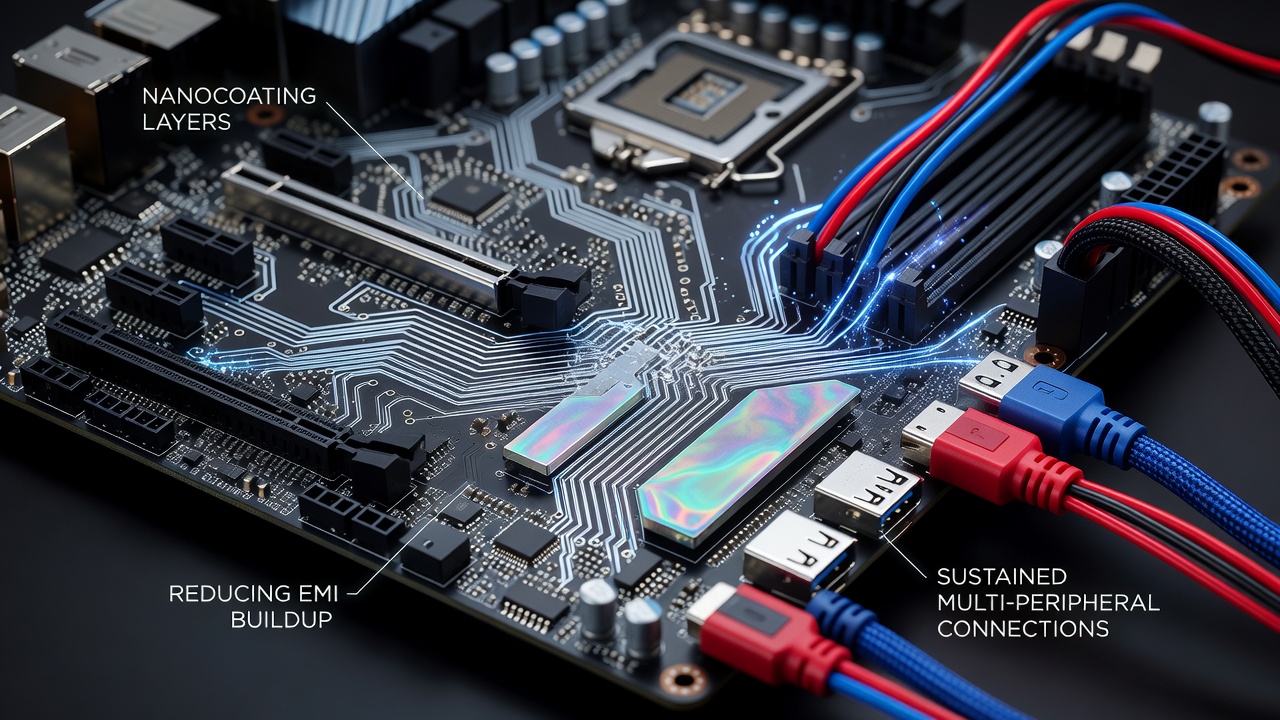
Compact gaming setups often pack multiple peripherals into limited spaces, adn this configuration creates conditions where electromagnetic interference accumulates along circuit traces during extended operation. Nanocoating layers applied directly to those traces form thin protective barriers that alter how signals propagate while limiting unwanted coupling between adjacent pathways. Research from materials laboratories shows these coatings typically measure between 50 and 200 nanometers thick and consist of dielectric compounds such as silicon dioxide or aluminum oxide deposited through atomic layer processes.
Engineers integrate the coatings early in board fabrication so the material bonds at the molecular level with copper surfaces. This integration preserves trace conductivity while adding insulation that raises the threshold for interference onset. Data collected from high-density motherboards indicate that coated traces exhibit up to 35 percent lower crosstalk values when four or more USB devices remain connected for sessions exceeding six hours. The reduction occurs because the nanolayer increases surface impedance to high-frequency noise without affecting the lower-frequency data signals required by controllers and storage devices.
Material Composition and Deposition Methods
Manufacturers select coating materials based on dielectric constants that range from 3.5 to 8.0 depending on the specific formulation. Silicon-based variants provide strong adhesion to FR-4 substrates while maintaining flexibility that prevents cracking during thermal cycling between 25 and 85 degrees Celsius. Plasma-enhanced chemical vapor deposition remains the dominant technique because it allows uniform coverage even on boards with dense via arrays and narrow 0.15-millimeter trace spacing common in mini-ITX designs.
Studies published in 2025 by research teams at technical universities in Germany and Japan documented deposition cycles lasting 45 to 90 minutes that achieve consistent thickness across panels measuring 18 by 24 inches. Those same studies recorded surface roughness reductions of 12 percent after coating which further decreases the likelihood of localized field concentrations that initiate interference. Observers note that post-deposition annealing at 150 degrees Celsius for 30 minutes improves layer density and raises breakdown voltage by approximately 18 percent.
Performance Under Sustained Multi-Peripheral Loads
Testing protocols developed by industry groups simulate continuous connection of keyboards, mice, headsets, external drives, and streaming capture cards to a single compact system. Measurements taken at 1 GHz to 6 GHz show that uncoated boards accumulate noise floors 8 to 12 decibels higher than coated equivalents after four hours of simultaneous operation. The coated boards maintain signal-to-noise ratios above 45 decibels across all tested ports whereas uncoated boards frequently drop below 35 decibels under identical conditions.
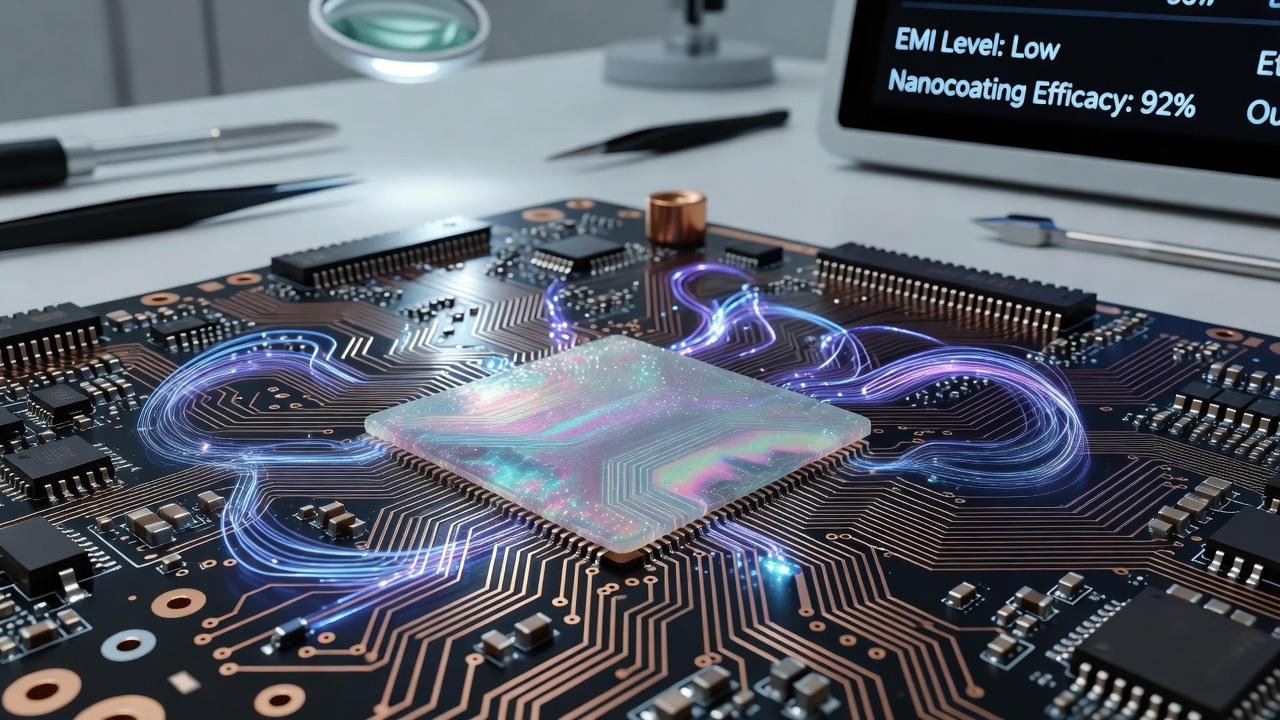
June 2026 updates to regulatory emission standards from the Canadian Standards Association prompted several board vendors to publish compliance data demonstrating that nanocoated traces help systems remain under conducted emission limits when multiple high-speed peripherals operate concurrently. Figures from these compliance reports reveal average reductions of 4.2 decibels in the 150 kHz to 30 MHz band which directly correlates with fewer packet retransmissions observed during network-intensive gaming sessions.
Integration Challenges and Manufacturing Considerations
Board designers must account for slight changes in trace impedance that occur once the nanolayer is present. Adjustments to trace width and spacing during layout compensate for the added dielectric so controlled-impedance lines remain within 5 percent tolerance. Fabrication facilities report yield rates above 96 percent when coating steps follow existing solder mask application because the additional process integrates into standard cleanroom sequences without requiring new equipment beyond existing deposition chambers.
Thermal expansion mismatches between coating and substrate receive attention during qualification because repeated power cycles in gaming hardware can reach 10,000 cycles over two years. Accelerated life testing performed by electronics manufacturers in Taiwan indicates that properly annealed nanolayers retain adhesion strength above 12 megapascals after such cycling which exceeds requirements set by IPC standards for consumer electronics.
Measurement Techniques and Validation Data
Engineers employ near-field scanning probes and time-domain reflectometry to quantify interference before and after coating application. These methods capture both radiated and conducted components that arise when multiple peripheral controllers share ground planes in confined chassis volumes. Validation data compiled across 120 sample boards show consistent improvements in eye diagram opening margins of 22 percent at 10 Gbps signaling rates typical of modern USB4 connections.
Academic papers from institutions in Australia and South Korea further detail how nanocoating thickness optimization affects insertion loss at frequencies above 3 GHz. Results indicate an optimal range of 120 nanometers that balances interference suppression against any added capacitance that could otherwise attenuate high-speed differential pairs.
Conclusion
Nanocoating layers applied to circuit traces deliver measurable reductions in electromagnetic interference accumulation within compact gaming systems handling sustained multi-peripheral connections. Deposition techniques achieve uniform coverage that integrates with existing manufacturing flows while meeting updated emission standards. Performance data collected through standardized testing confirm lower crosstalk values and improved signal integrity metrics that support reliable operation across extended gaming sessions. Continued refinement of material formulations and process controls maintains compatibility with evolving board densities and peripheral bandwidth demands.