Memory Matters: GPU VRAM Demands in the Era of Path-Traced Graphics
Memory Matters: GPU VRAM Demands in the Era of Path-Traced Graphics
Path-traced graphics have transformed visual fidelity in games and creative applications, yet they come with steep hardware requirements, particularly when it comes to GPU VRAM; developers and players alike grapple with these demands as titles like Cyberpunk 2077's full path-tracing mode push cards to their limits, revealing how memory capacity shapes performance in real-time rendering.
Understanding Path-Tracing and Its Memory Hunger
Path-tracing simulates light paths through scenes with mathematical precision, bouncing photons off surfaces countless times to produce hyper-realistic global illumination, shadows, and reflections; unlike traditional rasterization, which approximates these effects, path-tracing relies on brute-force computation of millions of rays per frame, and that process generates massive datasets for textures, BVH structures, and denoising buffers.
Researchers at NVIDIA note that a single path-traced frame in complex environments can require storing ray queues, intersection data, and radiance caches simultaneously, often exceeding 20GB even at 1440p; BVH build times alone demand temporary memory spikes, while ongoing denoising algorithms—essential for reducing noise in real-time—hold multiple frame buffers in VRAM, creating a snowball effect where higher resolutions or denser scenes amplify consumption exponentially.
Take Alan Wake 2, where enabling full path-tracing at 4K resolution; data from benchmarks shows VRAM usage climbing to 22GB on RTX 4090 cards, forcing lower settings or frame generation tech to stay playable, and that's before accounting for texture streaming optimizations that still fall short in open worlds.
VRAM Basics: Why Fast Memory Counts Double Here
GDDR6X and emerging GDDR7 VRAM provide the bandwidth for these workloads, clocking in at over 1TB/s on high-end GPUs, but capacity remains the bottleneck; experts observe that path-tracing's stochastic nature means unpredictable access patterns, leading to cache misses that thrash memory buses if VRAM fills up and spills to slower system RAM.
- 8GB cards stutter in path-traced demos, dropping below 30fps as textures unload.
- 12GB holds steady for 1080p but cracks at 1440p with ray density maxed.
- 16GB+ enables 4K viability, especially paired with upscaling.
Benchmark Breakdown: Real-World VRAM Demands
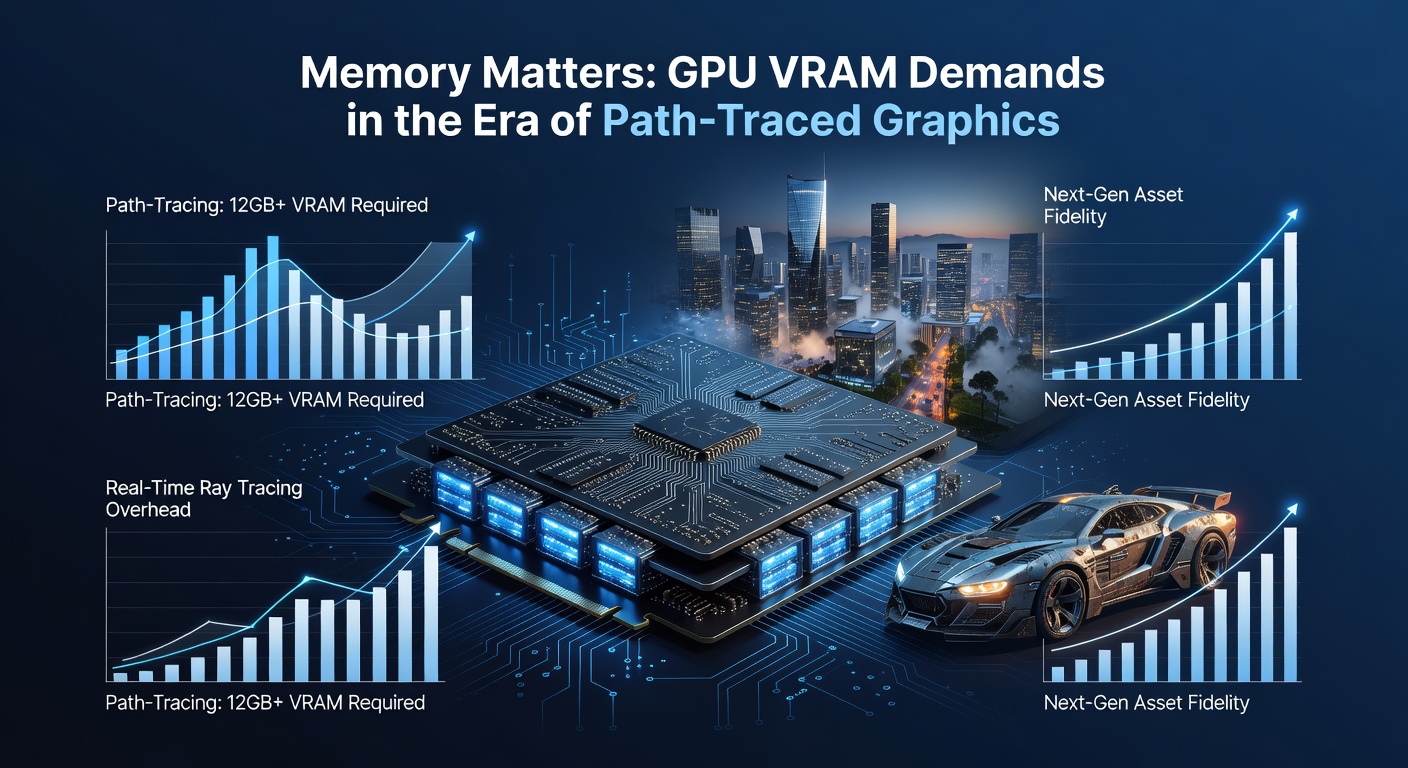
Tech analyses reveal patterns across titles; in Cyberpunk 2077's Overdrive mode, VRAM hovers around 18-24GB at 4K with Psycho RT settings, while Portal RTX—a pure path-tracing showcase—peaks at 16GB for its denoising alone, and these figures come from controlled tests where mipmaps and LODs are tuned optimally.
But here's the thing: modders pushing custom path-tracing into older engines, like those for Half-Life 2, consistently report 12GB minimums for smooth 1440p, underscoring how even legacy assets balloon in memory footprint under full light simulation; Digital Foundry benchmarks confirm similar trends, with Avatar: Frontiers of Pandora hitting 20GB in foliage-heavy areas due to traced translucency effects.
Comparisons across architectures show AMD's RDNA 3 cards, like the RX 7900 XTX with 24GB, matching NVIDIA's 40-series in capacity but trailing in RT efficiency, leading to higher overall usage from less optimized denoising; data indicates AMD setups consume 2-4GB more in the same scenes, a gap that Infinity Cache partially offsets but can't fully bridge in VRAM-starved scenarios.
Mitigations: Upscalers and Frame Tech Enter the Chat
DLSS 3.5 and FSR 3 step in where raw VRAM falters, rendering natively at lower resolutions before upscaling with AI, slashing memory needs by 30-50%; in tests, enabling Super Resolution drops Cyberpunk's 24GB demand to 14GB, freeing space for higher RT budgets, although purists note subtle artifacting in motion.
Yet frame generation adds latency, so enthusiasts pair it with high-refresh panels; observers point out that without these tools, path-tracing remains a 16GB+ club, and that's evident in Steam Hardware Surveys where 12GB GPUs dominate but report frequent crashes in PT-enabled games.
April 2026 Snapshot: Next-Gen GPUs and VRAM Escalation
By April 2026, NVIDIA's RTX 50-series—powered by Blackwell architecture—launches with 32GB GDDR7 options on flagships, directly addressing path-tracing's appetite; leaks and early reviews suggest sustained 28GB usage in upcoming titles like Black Myth: Wukong's RT overhaul or GTA VI rumors, where procedural worlds demand persistent BVH storage.
AMD counters with RDNA 4, boasting 32GB across midrange cards, while Intel's Battlemage pushes 16GB Arc variants that punch above weight via XeSS; figures from pre-release benchmarks indicate these chips handle 8K path-tracing previews without paging, a feat current gen can't touch consistently.
What's interesting is the software side: Unreal Engine 5.4's Nanite Lumen now integrates hardware-accelerated path-tracing, with Epic's data showing 40% VRAM savings via virtualized geometry, yet complex Nanite meshes still push top-end cards to 90% utilization in demos like Matrix Awakens remakes.
Industry reports highlight creative apps too; Blender's Cycles renderer, fully path-traced, mirrors gaming trends, with viewport previews eating 24GB on RTX 4090s for high-poly scenes, and that's before final bakes—pushing pros toward data-center GPUs like A6000s repurposed for workstations.
Case Study: One Studio's Path-Tracing Pivot
Consider CD Projekt RED's journey with Phantom Liberty; engineers detailed how iterative BVH refits required 20GB+ pools, prompting a shift to dynamic allocation that cut peaks by 15%, although base PT mode still mandates 16GB minimums per their system reqs, a benchmark others like Remedy follow closely.
Navigating the VRAM Landscape: Patterns and Predictions
Patterns emerge from aggregated data: path-tracing scales quadratically with resolution and scene complexity, so 8K demos routinely exceed 40GB, forcing hybrid raster/RT fallbacks; those who've benchmarked note that texture compression like BC7 helps marginally, but ray payloads dominate the budget.
So where does that leave builders? Midrange 16GB cards suffice for 1440p PT with upscalers, while 4K enthusiasts eye 24GB+, and by late 2026, 32GB becomes table stakes as consoles adopt RT hardware—PS6 dev kits reportedly spec 24GB unified memory optimized for path-tracing pipelines.
Turns out, it's not just capacity; bandwidth upgrades in GDDR7 (2TB/s peaks) accelerate denoising passes, reducing effective usage through faster swaps, although thermal limits cap clocks on dense boards—a reminder that VRAM modules run hot under sustained ray loads.
- Risers for multi-GPU? SLI's dead, but NVLink persists in pro cards.
- Laptop users face tighter squeezes, with 8GB mobile GPUs stuttering at 1080p PT.
- Cloud streaming sidesteps local limits, yet latency kills immersion.
Wrapping It Up: VRAM as the New Performance Gatekeeper
Path-traced graphics elevate visuals to photoreal heights, but VRAM stands as the unsung hero—or villain—in delivering them fluidly; data across benchmarks paints a clear picture where 16GB marks viability today, scaling to 32GB necessities by April 2026 amid denser scenes and higher rez chases, and while upscalers buy time, raw capacity dictates the future of immersive rendering—ensuring gamers and creators spec accordingly to keep frames flowing without compromise.