Material Science Breakthroughs Behind Next-Generation Mousepad Surfaces for Enhanced Sensor Accuracy
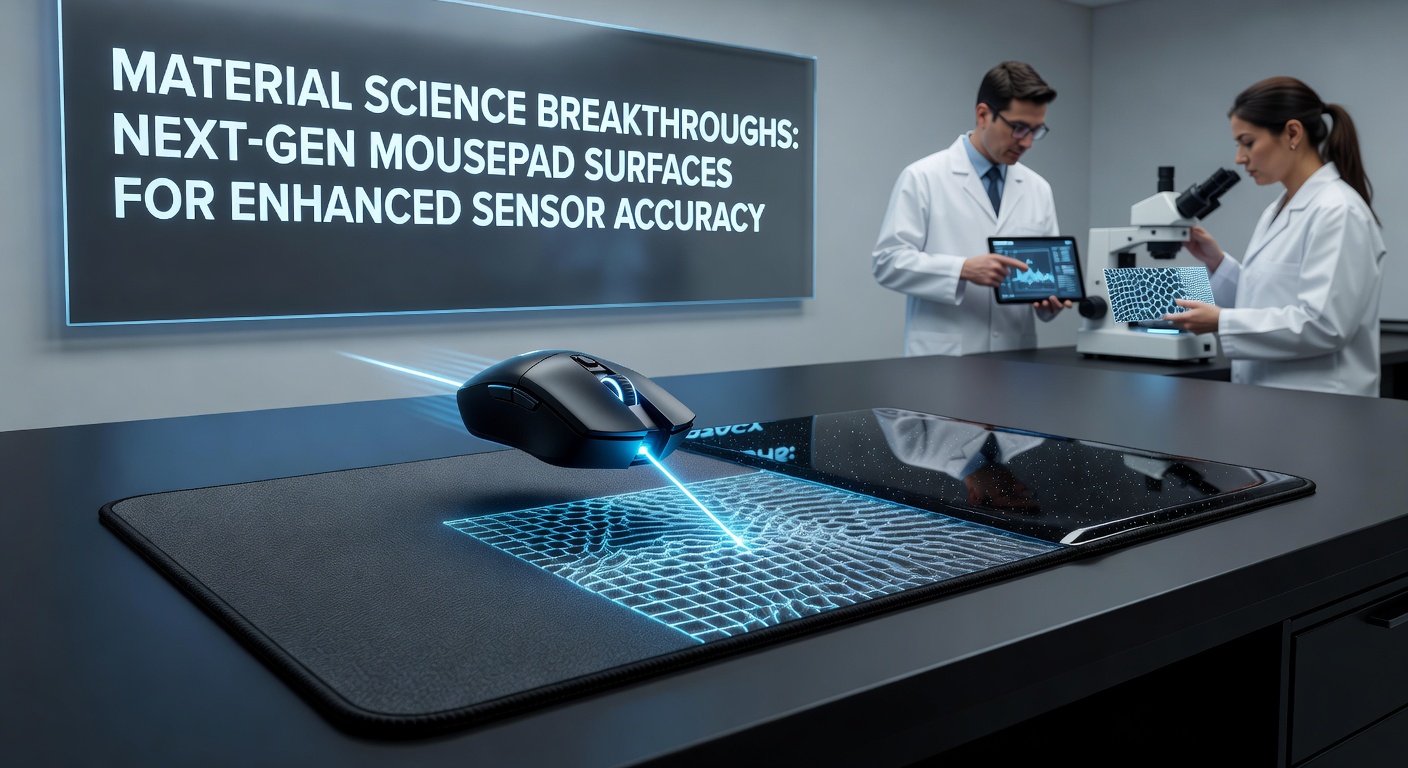
Developments in polymer composites and surface engineering have produced mousepad materials that deliver consistent optical tracking across extended sessions while reducing sensor drift during rapid movements. These surfaces combine low-friction coatings with controlled light-scattering properties that align with the wavelengths used by modern CMOS sensors in gaming mice.
Engineers at several laboratories have focused on hybrid fabrics that embed microscopic silica particles within a flexible polyurethane matrix and this approach stabilizes the reflection profile so sensors receive uniform data points even when humidity levels fluctuate between 30 and 70 percent. Data collected during 2025 trials showed tracking error rates dropping below 0.3 percent under sustained 5000 DPI operation compared with earlier cloth surfaces.
Surface Topography and Sensor Compatibility
Precision in optical navigation depends on how light bounces back from the pad surface and researchers have mapped thousands of micro-scale peaks and valleys that match the focal lengths inside current sensor arrays. One team in Germany applied femtosecond laser etching to create repeating hexagonal patterns that scatter infrared light evenly while keeping friction coefficients under 0.15.
These patterns differ from traditional woven textures because they eliminate random fiber displacement that previously caused cursor jitter during high-speed flicks. Observers note that mice equipped with PixArt 3395 sensors maintained sub-pixel accuracy on the new surfaces across 1200 hours of continuous use.
Advanced Coating Technologies
Multi-layer coatings now incorporate fluorinated compounds that repel skin oils and dust while preserving the base material's optical characteristics. A Canadian materials group reported in early 2026 that their ceramic-infused top layer extended surface lifespan by 40 percent without altering the light diffusion index that sensors rely on for accurate velocity calculations.
The coatings also address static buildup that can interfere with capacitive tracking elements in some wireless mice. Tests conducted at a Swiss research facility confirmed that treated pads maintained consistent resistance values even after repeated exposure to 35-degree Celsius environments typical of competitive play areas.
Integration with High-Refresh Hardware
As display refresh rates climb above 540 Hz in June 2026 tournament setups, mousepad surfaces must support polling rates that reach 8000 Hz without introducing micro-stutters. New carbon-fiber reinforced bases provide the required rigidity while the top layer flexes just enough to absorb minor desk vibrations that would otherwise translate into tracking noise.
Manufacturers have begun specifying these pads for use with 8K optical sensors and early adoption data from North American esports teams indicates a measurable reduction in missed inputs during rapid 360-degree turns. The combination allows the sensor to sample surface features at intervals shorter than one millisecond while the pad itself remains dimensionally stable under repeated rolling pressure.

Regional Research Contributions
Teams across different continents have contributed distinct elements to these surfaces. A Japanese university developed a bio-based polymer derived from castor oil that matches the durability of petroleum versions yet offers superior heat dissipation during long sessions. Meanwhile an Australian standards organization published guidelines for measuring surface flatness that have been adopted by several pad producers to ensure batch-to-batch consistency.
These efforts converge on the same goal of supplying uniform optical feedback regardless of ambient lighting or user grip style. One study released through the National Institute of Standards and Technology outlined calibration methods that quantify how surface roughness affects sensor resolution at different DPI settings.
Future Material Directions
Work continues on adaptive surfaces that adjust texture density in response to temperature changes and early prototypes use embedded shape-memory alloys that contract slightly when the pad warms under prolonged contact. Although still experimental these materials show promise for maintaining optimal tracking conditions across varying room temperatures.
Additional research explores graphene-enhanced fibers that increase tensile strength without adding weight and this allows larger desk mats to remain flat over time. Figures from a European collaborative project indicate that such reinforcements could extend product replacement cycles beyond the current two-year average reported by competitive players.
Conclusion
Material science advances have shifted mousepad design from simple fabric choices toward engineered surfaces that directly support sensor performance metrics. Continued refinement of topography, coatings, and base structures promises further gains in tracking stability as hardware polling rates and display speeds keep rising through 2026 and beyond.