Inside Adaptive Sync Protocols and Their Role in Smoothing Frame Delivery Across Varied Display Panels During Mixed Workload Sessions
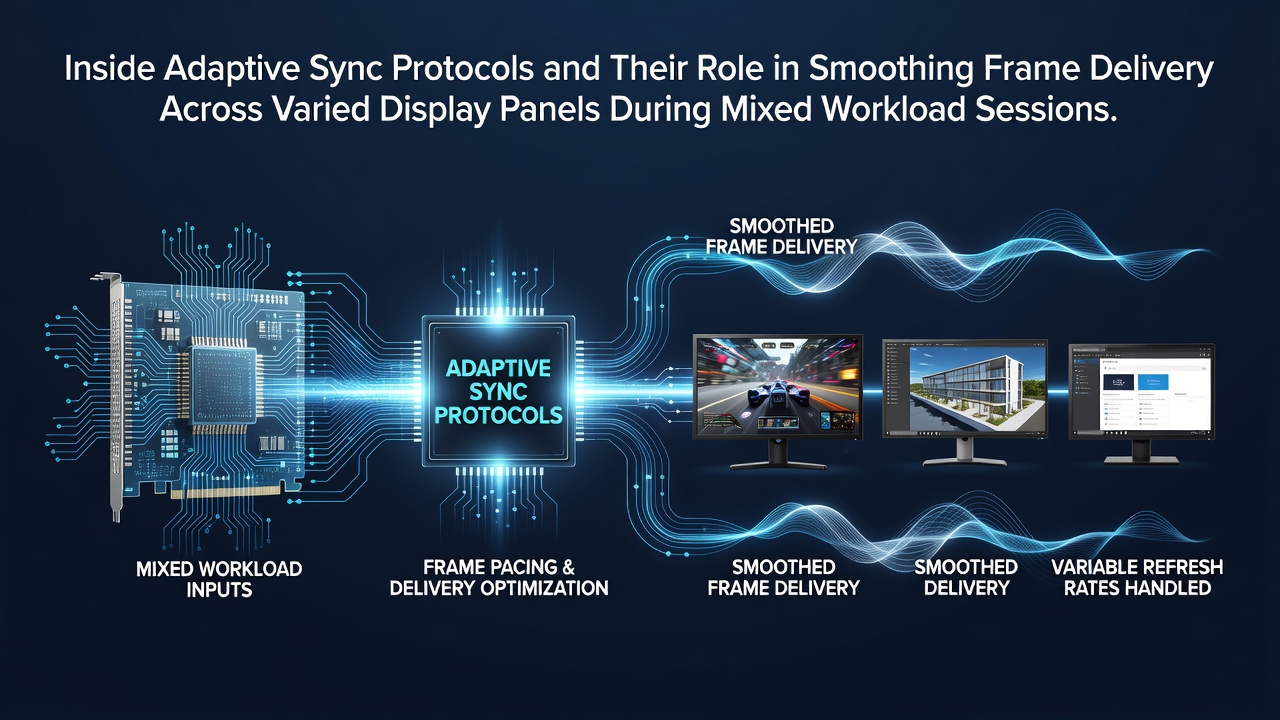
Adaptive sync protocols have become central to modern display technology as they match a monitor's refresh rate to the output frame rate of a graphics source and this approach reduces screen tearing along with stuttering that often appears when frame delivery fluctuates. These protocols operate through variable refresh rate mechanisms embedded in standards such as VESA Adaptive-Sync and they allow panels to dynamically alter their refresh timing without relying on fixed vertical sync intervals. Observers note that the core process involves continuous communication between the GPU and the display controller so that each new frame triggers a refresh only when it arrives and this eliminates the mismatch that produces visual artifacts during demanding sessions.
Core Mechanics of Adaptive Sync Implementation
DisplayPort and HDMI interfaces carry the adaptive sync signaling data adn the GPU transmits frame completion timestamps that the monitor uses to adjust its vertical blanking period accordingly. Engineers designed these handshakes to function within specific timing windows and they accommodate frame rates that range from as low as 30 Hz up to the panel's maximum rated refresh while maintaining synchronization throughout. Data from industry testing shows that the protocol overhead remains minimal because the additional metadata packets fit within existing blanking intervals and this keeps overall latency increases negligible across certified hardware combinations.
Panel Technology Interactions with Variable Refresh
Liquid crystal panels respond differently to rapid refresh changes compared with organic light emitting diode matrices and the liquid crystal response times in IPS and VA technologies require careful compensation algorithms within the monitor firmware. OLED panels exhibit near instantaneous pixel transitions yet they introduce their own constraints around brightness uniformity when refresh rates vary quickly during mixed content streams. Studies conducted by display research groups indicate that adaptive sync implementations on OLEDs achieve smoother motion portrayal in high contrast scenes because pixel decay happens faster and this reduces the ghosting sometimes visible on LCDs when frame pacing shifts abruptly.
Managing Frame Delivery in Mixed Workload Environments
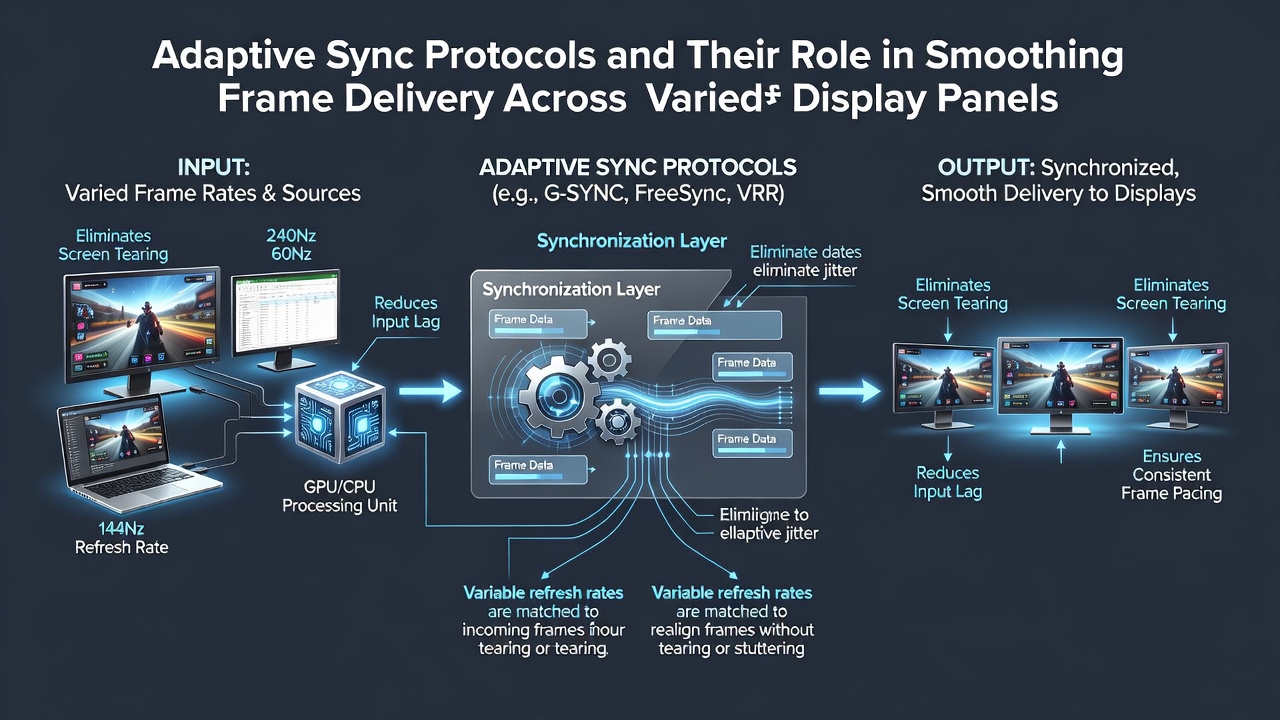
Mixed workload sessions combine real time rendering tasks with background processes such as video encoding or data transfers and these combinations produce irregular frame intervals that challenge traditional fixed refresh displays. Adaptive sync counters the resulting jitter by stretching or compressing the refresh cycle to align with each arriving frame and this keeps perceived motion continuous even when instantaneous frame times spike. Application examples from professional content creation setups demonstrate that enabling adaptive sync during simultaneous 3D viewport manipulation and file compression routines maintains visual coherence without forcing users to close auxiliary applications.
Certification programs from standards organizations verify that compatible displays handle these transitions within defined tolerance bands and they publish lists of approved timings that manufacturers must meet before claiming compliance. In June 2026 several panel makers introduced updated controller chips that extend the lower bound of supported refresh rates down to 24 Hz adn this change benefits users who alternate between high frame rate gaming and slower cinematic playback within the same session.
Cross Platform Considerations and Signal Integrity
Operating system level drivers expose adaptive sync controls through graphics APIs and applications can query the current display capabilities before committing to variable rate output streams. Windows and Linux distributions both include native support for these extensions while macOS relies on external display implementations that still adhere to the same underlying timing specifications. Signal integrity remains a priority because longer cable runs or lower quality interconnects can introduce jitter in the synchronization packets and this occasionally leads to brief desynchronization events that require the link to renegotiate.
According to reports published by the Video Electronics Standards Association the latest revisions to the Adaptive-Sync specification include provisions for multi monitor topologies where each display maintains independent refresh timing yet shares a common timing reference from the host system. European testing facilities have corroborated these findings through standardized measurement suites that track frame delivery variance across extended operation periods.
Future Refinements in Protocol Efficiency
Engineers continue to refine the metadata structures that carry frame timing information and newer iterations reduce the number of required packets per refresh cycle which frees bandwidth for higher resolution or color depth transmissions. Research institutions examining high dynamic range workflows have measured improvements in motion clarity when adaptive sync operates alongside variable backlight modulation and these combined techniques deliver consistent results even as system loads fluctuate throughout a typical workday. Observers tracking adoption rates note increasing integration of adaptive sync support in portable displays where power constraints previously limited variable refresh implementations.
Conclusion
Adaptive sync protocols provide a robust framework for aligning display refresh behavior with variable frame production across diverse panel types and workload patterns and their continued evolution supports smoother visual experiences in both professional and consumer environments. Ongoing standardization efforts ensure broader compatibility while hardware refinements address the specific characteristics of emerging display technologies.