How NAND Endurance Metrics Influence Asset Streaming Consistency in Petabyte-Scale Game Archives
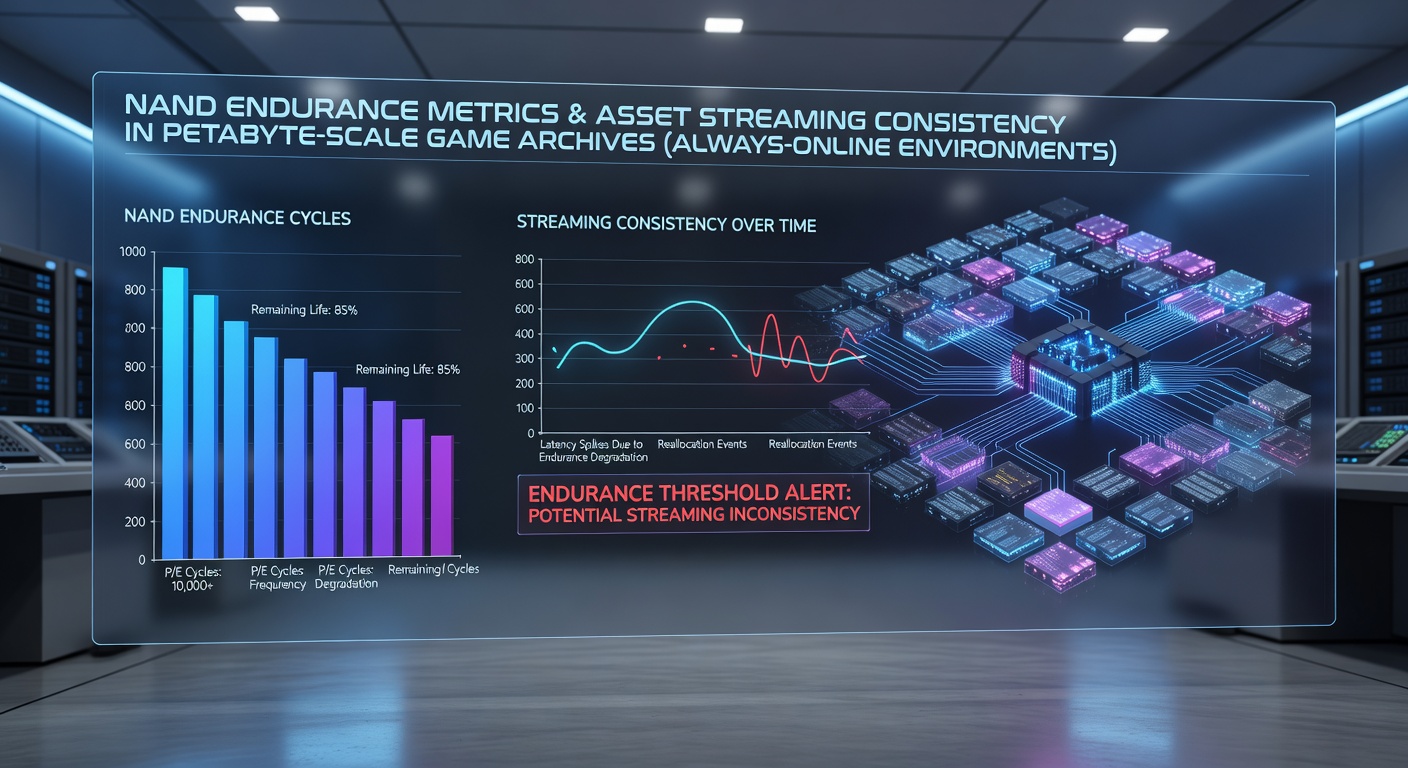
Petabyte-scale game archives in always-online titles rely on NAND flash arrays for rapid asset retrieval and constant updates, yet the endurance characteristics of those drives directly determine whether streaming remains stable over months of 24/7 operation. NAND cells support a finite number of program-erase cycles before bit-error rates climb, and game servers write fresh texture packs, shader caches, and player-generated content every hour.
Endurance Metrics That Govern Long-Term Performance
Manufacturers rate drives using terabytes written and drive writes per day figures that quantify how much data can move through the array before spare-block reserves drop below safe thresholds. Research from the Storage Networking Industry Association shows that consumer-grade TLC NAND typically sustains between 1,000 and 3,000 cycles while enterprise QLC variants used in cold archives manage far fewer, and these numbers become critical once a single title accumulates hundreds of petabytes in cumulative writes across its update cycle.
Wear-leveling algorithms distribute those writes evenly, yet they cannot eliminate localized hot spots created when frequently accessed map sections receive repeated delta patches. Error-correction code overhead grows as cells age, and the resulting latency spikes translate directly into asset-streaming hiccups visible to players in real time.
Streaming Workloads in Live-Service Environments
Always-online games maintain persistent connections that pull new geometry, audio banks, and animation data without client restarts, so the backend must serve both read-heavy streaming requests and the write traffic that accompanies each content deployment. In May 2026 several major titles crossed the one-petabyte active archive mark, and operators reported that drives rated at 0.3 DWPD began showing measurable increases in tail-latency once cumulative writes approached 85 percent of rated endurance.

Background compaction routines that reclaim invalid pages compete with foreground read operations, and when endurance margins shrink those routines run more frequently. The result is a gradual shift from predictable sub-millisecond response times to occasional multi-millisecond pauses that manifest as texture pop-in or brief loading stutters on the client side.
Architectural Mitigations and Their Limits
Operators deploy mixed-tier storage pools that place endurance-sensitive write buffers on higher-grade SLC or MLC caches while colder asset libraries reside on lower-endurance QLC drives refreshed through scheduled migration jobs. Data from the University of California, San Diego indicates that such tiering can extend effective array lifespan by 40 percent, yet the migration traffic itself consumes additional program-erase cycles and must be scheduled during low-traffic windows to avoid compounding latency.
Over-provisioning spare capacity provides another buffer, allowing the flash translation layer to retire worn blocks without immediate capacity loss. Still, once the spare pool falls below five percent, garbage-collection pauses lengthen and the probability of read-retry operations rises measurably across petabyte-scale namespaces.
Operational Monitoring Practices
Telemetry frameworks track normalized wear indicators, uncorrectable bit-error rates, and program-erase cycle counts per drive, feeding dashboards that trigger preemptive drive replacement before streaming consistency degrades. European research consortia have documented that fleets replaced at 80 percent rated endurance maintain steadier latency distributions than those pushed to 95 percent, because early swaps avoid the steep error-rate curve that appears in the final portion of a NAND device's life.
Capacity forecasting models now incorporate both organic player-driven writes and the scheduled content drops that accompany seasonal events, allowing operators to project when endurance headroom will tighten and to order replacement media with sufficient lead time.
Conclusion
NAND endurance metrics therefore function as a hidden throttle on asset-streaming reliability in massive always-online deployments, shaping everything from patch deployment cadence to the frequency of storage-tier migrations. Continued refinement of wear-leveling firmware, smarter tiering policies, and earlier replacement thresholds keeps streaming performance within acceptable bounds even as archive sizes continue their upward trajectory.