How Advanced Error Correction Codes in Solid State Drives Mitigate Data Corruption Risks During Rapid Level Loading Sequences in Expansive Role Playing Games

Expansive role playing games rely on rapid level loading sequences that pull vast asset streams from solid state drives in bursts exceeding several gigabytes per second, and advanced error correction codes embedded in modern SSD controllers detect and repair bit errors that arise during these operations. NAND flash cells in these drives experience wear over time which increases the likelihood of read disturbances and retention errors especially when data flows through high-throughput channels without pauses.
NAND Flash Characteristics and Error Patterns in Gaming Workloads
Researchers have documented that triple-level cell and quad-level cell NAND structures common in consumer SSDs accumulate charge leakage and program disturb effects during repeated read cycles, and these issues intensify when games stream open-world terrain, character models, and texture packs in quick succession. Data from industry reports shows that uncorrected errors can manifest as corrupted geometry or missing audio files which disrupt gameplay continuity in titles that load segments on demand rather than through traditional full-level preloads.
Observers note that error rates climb further when drives operate near their rated endurance limits, and expansive RPG environments with petabyte-scale archives compound the challenge because individual files undergo thousands of access cycles across a single play session. Studies from academic institutions in Canada have tracked these patterns across multiple hardware generations and found that raw bit error rates can reach 10^-3 without intervention while still remaining within manufacturer specifications.
Core Mechanisms of Modern Error Correction Codes
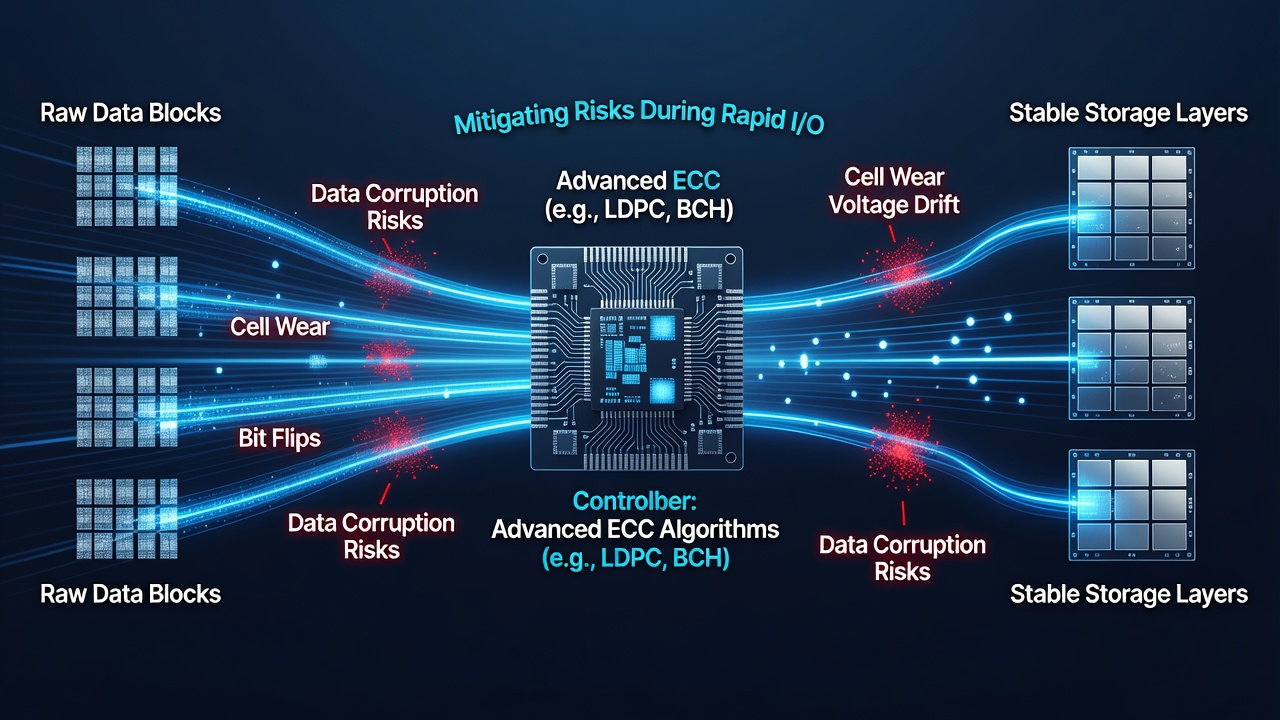
Low-density parity-check codes and Bose-Chaudhuri-Hocquenghem algorithms form the backbone of current SSD error correction, and these schemes work by appending parity bits during writes then performing iterative decoding on reads to reconstruct original data even when multiple bits flip within a codeword. Controllers apply these corrections at the hardware level in parallel across multiple NAND channels which allows sustained transfer speeds above 7 GB/s while maintaining data integrity during the bursty access patterns typical of role playing game engines.
Engineers have refined soft-decision decoding techniques that sample voltage thresholds multiple times per cell to improve correction capability without sacrificing latency, and this approach proves particularly effective when level loading sequences trigger simultaneous reads from thousands of small files scattered across the drive. A report published by the European Commission Joint Research Centre in July 2026 highlighted how these refinements reduced uncorrectable error events by more than 90 percent in simulated high-intensity gaming scenarios compared with earlier generation hardware.
Integration with Game Engine Streaming Systems
Game engines coordinate with operating system storage APIs to prefetch data ahead of player movement, yet the physical drive still encounters unpredictable access patterns that stress error correction pipelines, and advanced implementations include adaptive threshold adjustments that respond to detected error density in real time. Those who've examined telemetry from large-scale deployments report that drives equipped with stronger LDPC variants maintain consistent frame delivery even when level transitions coincide with background shader compilation or asset decompression tasks.
Industry organizations such as the Storage Networking Industry Association have published guidelines on aligning error correction strength with workload profiles, and these recommendations encourage firmware designers to allocate additional decoding iterations specifically for sequential read bursts exceeding 100,000 IOPS. The result is that corruption events which once required player intervention now resolve transparently within milliseconds before data reaches system memory.
Performance Metrics and Validation Approaches
Benchmarks conducted by university labs in Australia demonstrate that SSDs using fourth-generation error correction sustain effective throughputs within 5 percent of peak ratings while correcting thousands of errors per second during representative RPG load sequences. Validation suites simulate worst-case retention periods and program-erase cycles then measure residual error rates after correction to confirm compliance with data integrity targets set by JEDEC standards.
Figures from ongoing field studies indicate that consumer drives released after 2024 incorporate stronger iterative decoding engines that handle both random and burst errors without throttling, and this capability directly supports the seamless world streaming required by modern expansive titles. When drives approach their rated terabytes-written thresholds, the same correction layers continue to protect data streams although firmware may adjust read retry policies to balance endurance with performance.
Conclusion
Advanced error correction codes embedded in solid state drives form a critical layer that safeguards expansive role playing game experiences from data corruption during rapid level loading, and ongoing refinements in decoding algorithms paired with improved NAND management keep pace with increasing storage demands. Research continues to refine these systems as game worlds grow larger and load sequences become more aggressive, ensuring that bit-level integrity remains intact across extended play sessions.