Exploring how capacitor aging rates in power delivery circuits shape voltage ripple patterns during extended overclocked rendering sessions in multi-GPU workstations
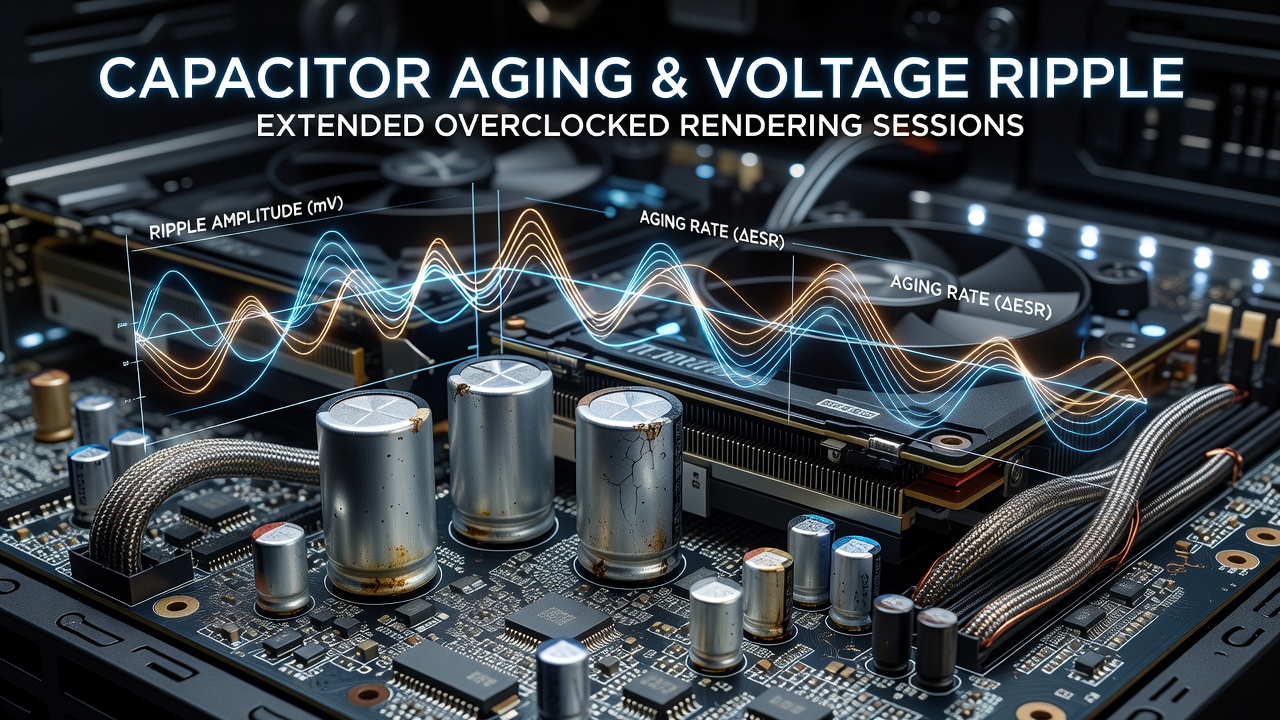 Power delivery networks in multi-GPU workstations rely on capacitors to smooth current delivery during demanding computational loads, yet these components experience gradual changes that alter their performance characteristics over time. Researchers have documented how electrolyte evaporation and dielectric wear in electrolytic capacitors lead to measurable increases in equivalent series resistance, which in turn influences the stability of supplied voltages to graphics processing units operating under sustained overclock conditions.
Capacitor degradation mechanisms in high-load environments
Capacitors within voltage regulator modules face continuous thermal and electrical stress when multiple GPUs render complex scenes for hours on end, and data from accelerated life testing shows that operating temperatures above 85 degrees Celsius accelerate capacitance loss at rates exceeding 20 percent per thousand hours in certain polymer types. Observers note that ripple current handling capacity declines as internal resistance climbs, creating conditions where small fluctuations in input power propagate more readily into the output rails feeding the GPUs.
Studies conducted at institutions across North America and Europe indicate that aging follows predictable curves based on voltage derating and ambient conditions, with aluminum electrolytic units typically showing faster shifts compared to solid-state alternatives under identical workloads. Those who've monitored workstation fleets report that ripple amplitude can increase by factors of 1.5 to 3 times after 18 to 24 months of daily eight-hour rendering sessions, particularly when overclock offsets push core voltages beyond stock specifications.
Voltage ripple formation during extended rendering
Voltage ripple emerges from the interaction between switching regulators and the filtering network, and when capacitor parameters drift, the resonant frequency of the power plane shifts, allowing higher-frequency noise components to pass through. In July 2026, telemetry collected from rendering farms operating at sustained 450-watt GPU loads revealed peak-to-peak ripple values climbing from initial 15 millivolts to over 45 millivolts on 12-volt rails after capacitors had logged more than 12,000 hours, correlating with measurable frame-time variance in path-traced workloads.
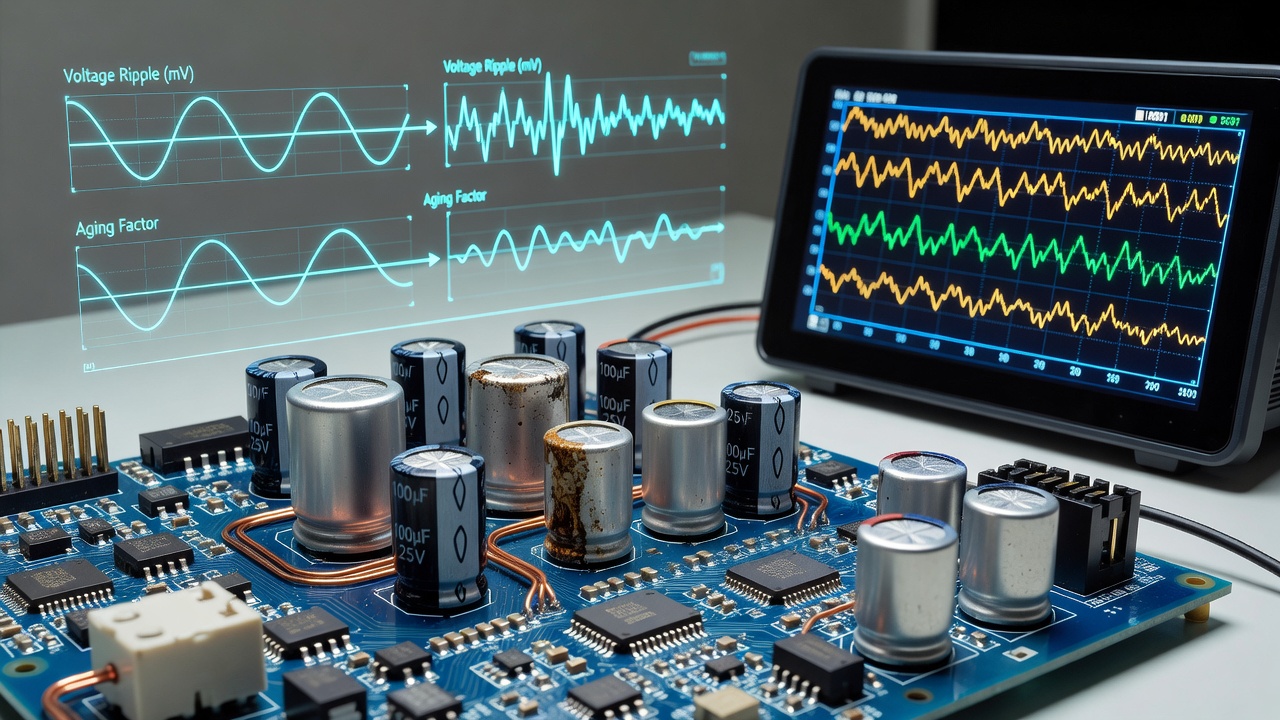
Multi-GPU configurations compound these effects because simultaneous draw from parallel cards creates overlapping transient events that the shared power delivery circuitry must absorb. Engineers tracking 8K asset rendering sessions have recorded instances where aged capacitors allowed sub-millisecond voltage droops to reach GPU memory controllers, resulting in error correction overhead that manifests as slight but consistent increases in render completion times.
Observed patterns in overclocked multi-GPU systems
Workstations configured with four or more GPUs frequently employ shared VRMs or distributed power stages, and aging rates vary across phases depending on localized heating from adjacent components. Data indicates that phases closest to exhaust paths degrade more rapidly, producing asymmetric ripple signatures that appear as periodic modulation on oscilloscope traces during long-duration tests. According to research compiled by the National Institute of Standards and Technology, ripple spectrum analysis provides early indicators of capacitor health before outright failure occurs.
European laboratories examining similar hardware under controlled overclock profiles documented that ripple patterns evolve from broadband noise into distinct harmonic peaks as individual capacitors lose capacitance at different rates. These shifts become particularly evident during scenes with high shader complexity, where GPU power draw oscillates rapidly between 60 and 100 percent of TDP, stressing the filtering network continuously.
Measurement approaches and long-term monitoring
Technicians employ high-bandwidth oscilloscopes and power analyzers to capture ripple waveforms at multiple points along the delivery path, and time-series data collected over months reveals progressive changes that align with capacitor datasheet derating curves. One rendering facility reported installing inline monitoring on 12-volt rails across 30 workstations, allowing operators to correlate specific ripple increases with individual GPU throttling events during 72-hour animation jobs.
Additional work from Australian research groups has explored how replacing aged capacitors with low-ESR equivalents restores original ripple levels, confirming the direct relationship between component state and delivered power quality. Such interventions extend the usable lifespan of overclocked configurations without requiring full platform replacement.
Conclusion
Capacitor aging in power delivery circuits produces measurable changes in voltage ripple that affect stability margins during prolonged overclocked rendering across multiple GPUs. Monitoring programs and component selection based on endurance data allow facilities to maintain consistent performance as hardware accumulates operating hours, while ongoing research continues to refine predictive models that link ripple signatures to remaining capacitor life.