Examining Voltage Regulator Module Configurations Across Competing GPU Architectures in Sustained Ray Tracing Workloads Within Compact Builds
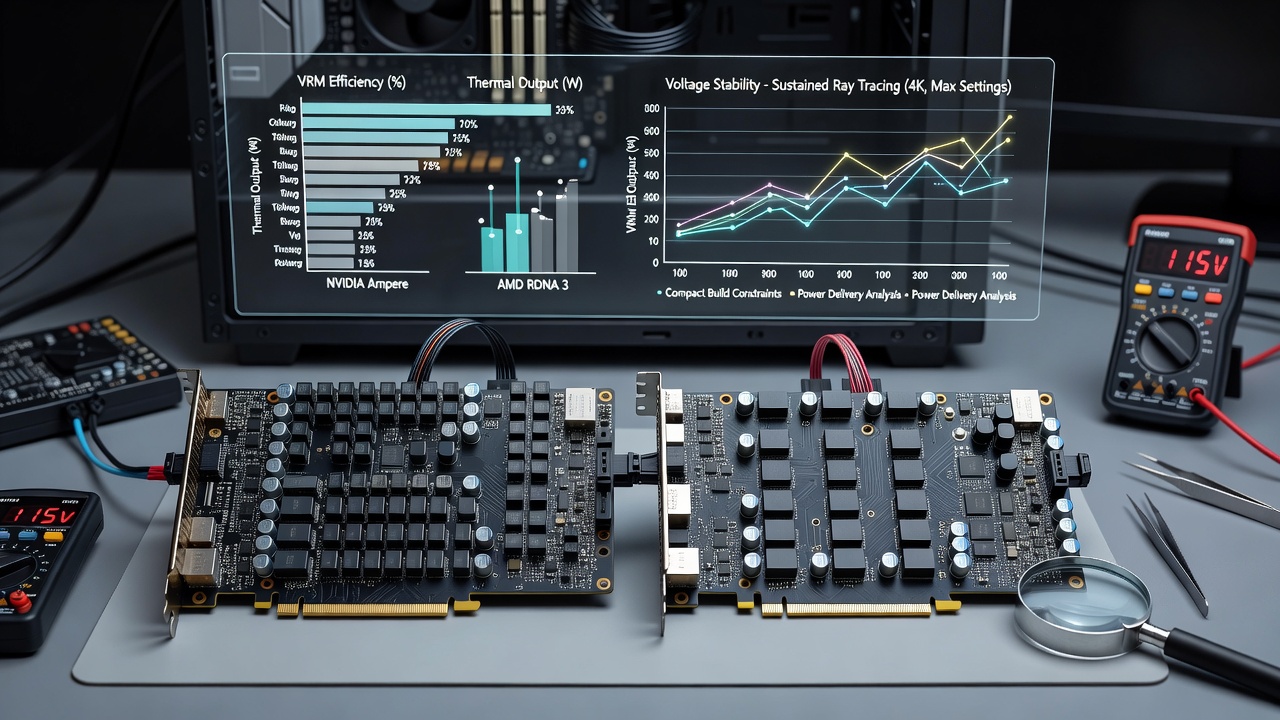
Compact PC builds place unique demands on power delivery systems, and voltage regulator modules must maintain stable output while GPUs handle extended ray tracing sessions that push power draw and heat generation to consistent peaks. Data from hardware evaluations shows that different GPU architectures approach VRM design with distinct phase counts, component layouts, and thermal solutions that affect performance under prolonged loads.
Core Functions of GPU Voltage Regulator Modules
VRMs convert 12V PSU input into the lower voltages required by GPU cores, memory, and auxiliary circuits, and this process becomes critical during ray tracing because those workloads sustain high utilization rates that exceed typical rasterization demands. Observers note that phase count directly influences current handling capacity, while MOSFET quality and inductor specifications determine efficiency and heat output in space-constrained environments where airflow remains limited.
Architectures from major vendors differ in how they distribute power phases across core and memory rails, and studies conducted through mid-2026 reveal measurable differences in transient response when multiple rays bounce through complex scenes for extended periods. Those who've measured board-level telemetry find that compact chassis restrict heatsink size, forcing VRMs to rely more on PCB copper layers and case fans rather than dedicated cooling hardware.
Architecture-Specific VRM Approaches
NVIDIA designs in recent generations typically employ higher phase counts on flagship models, pairing them with stacked power stages that allow finer current control during sustained ray tracing calculations. AMD configurations often balance phase distribution between compute units and high-bandwidth memory interfaces, and this approach shows distinct thermal signatures when workloads maintain 90 percent or greater utilization over hours rather than minutes. Intel's Arc implementations incorporate integrated power delivery elements that researchers have tracked through independent testing platforms, revealing how on-package regulators interact with external VRM stages under continuous path-tracing demands.
Figures from July 2026 benchmarks indicate that phase doubling techniques appear more frequently in designs targeting small form factor users, because these methods reduce voltage ripple that can otherwise trigger thermal throttling when ambient temperatures inside compact cases climb steadily. Data indicates the ball remains in the designers' court when balancing component density against long-term stability, and case studies from multiple vendors illustrate how inductor placement near exhaust paths improves heat dissipation without requiring larger coolers.
Thermal and Spatial Constraints in Compact Systems
Small chassis limit vertical clearance and directed airflow, so VRM components must shed heat through conduction into the PCB and eventual convection from case surfaces. Ray tracing workloads keep GPU dies at elevated power states for longer durations than many other tasks, and this sustained profile exposes weaknesses in phase synchronization that appear less frequently during bursty loads. Those monitoring internal temperatures report that memory VRM sections often reach higher peaks than core sections because high-bandwidth memory draws remain elevated throughout frame rendering cycles.
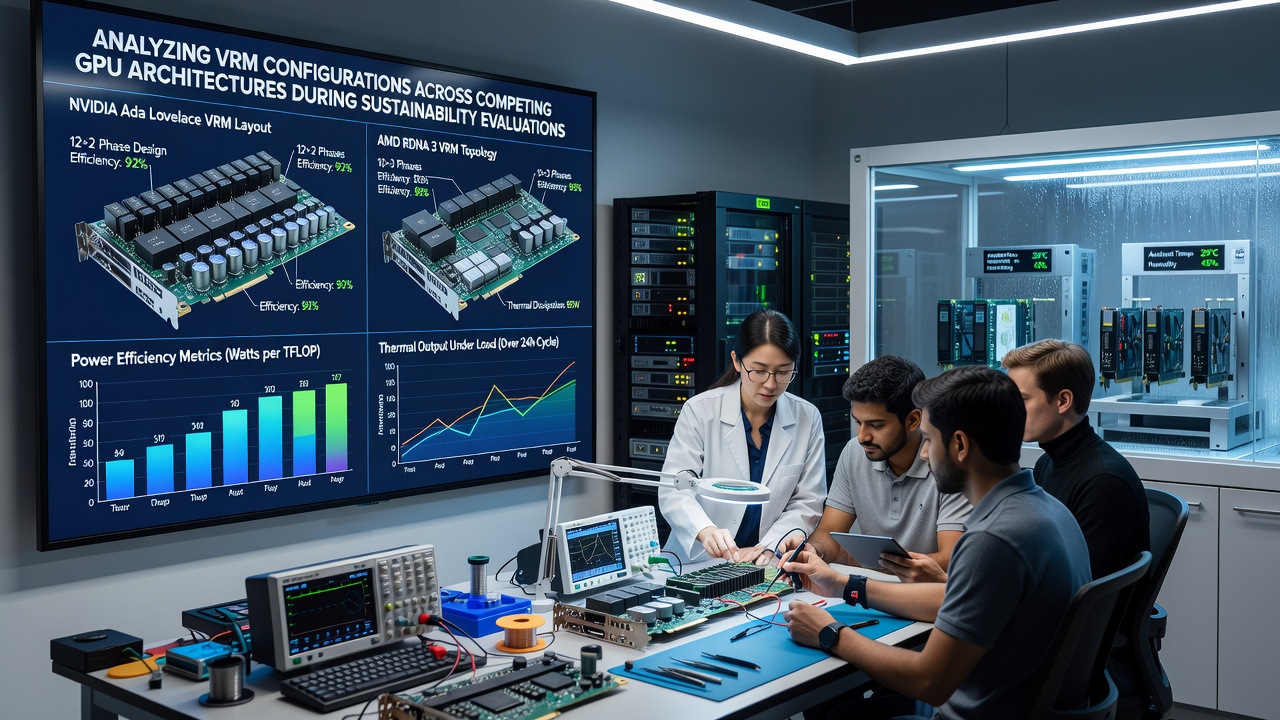
Evidence suggests that compact builds benefit from VRMs with integrated temperature sensors that feed real-time data back to firmware, allowing dynamic phase shedding when individual components approach limits. Researchers at institutions across North America and Europe have documented how these adaptive controls maintain consistent frame delivery even as case temperatures rise during multi-hour sessions. What's notable is the way some layouts position high-efficiency components directly under GPU coolers, borrowing airflow that would otherwise bypass power stages entirely.
Comparative Workload Measurements
Testing protocols that apply consistent ray tracing scenes across architectures reveal differences in how quickly VRM temperatures stabilize and how much headroom remains before protection circuits activate. One evaluation series tracked power phase efficiency at 4K resolutions with full ray tracing enabled, showing architecture-specific patterns in efficiency curves once loads exceeded 30 minutes. Observers note that designs incorporating gallium nitride transistors demonstrate lower switching losses under these conditions, although adoption rates vary between vendors.
According to findings published by the IEEE on power electronics in graphics hardware, phase interleaving techniques reduce output noise that can otherwise affect memory stability during extended asset streaming. Separate work from Australian university labs has examined how compact form factors alter the effectiveness of traditional heatsink solutions, and those results align with field measurements taken in production small form factor systems running continuous ray tracing applications.
Conclusion
Analysis of VRM configurations across current GPU architectures demonstrates clear variations in phase implementation, thermal management, and efficiency under sustained ray tracing conditions inside compact builds. Measurements collected through 2026 highlight how these differences manifest in temperature profiles and power stability when systems operate without the generous airflow found in larger cases. Continued evaluation of these components provides objective data that informs both hardware selection and case design choices for users prioritizing dense builds.