Examining Quantum Dot Layer Degradation Patterns Under Prolonged HDR Exposure That Affect Color Volume Retention in High-Refresh Desktop Displays During Extended Asset-Heavy Sessions
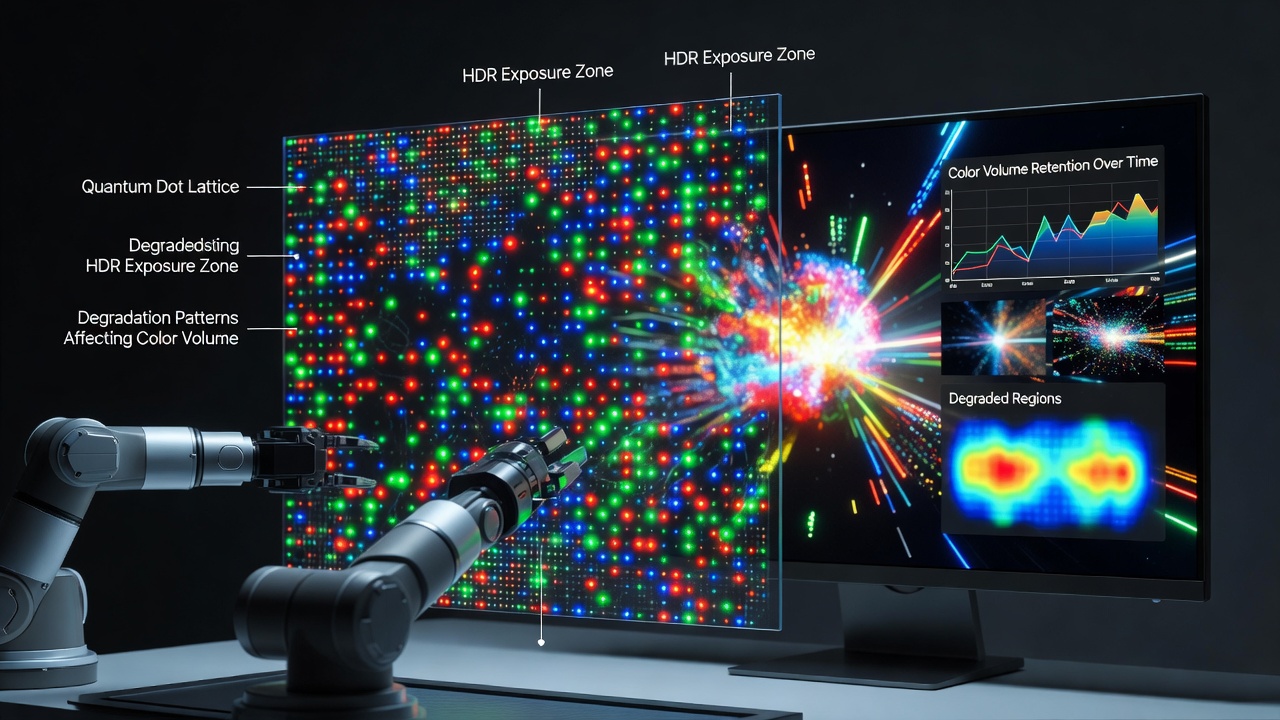
Quantum dot layers integrated into high-refresh desktop displays deliver wide color gamuts through precise light conversion yet face measurable degradation when subjected to continuous high dynamic range brightness levels, and observers note that this process directly influences color volume retention during prolonged sessions with graphically intensive content such as large-scale game environments or asset creation workloads.
Quantum Dot Fundamentals in Display Technology
Manufacturers embed quantum dots as nanoscale semiconductor particles that absorb shorter wavelengths and emit precise colors, and this mechanism allows desktop monitors operating at 144Hz or higher to achieve expanded color volumes while maintaining response times suitable for fast-paced applications; data from industry testing indicates these particles sit in thin films positioned above blue LED backlights, where they convert light efficiently until cumulative exposure begins to alter their optical properties.
HDR Exposure and Its Cumulative Effects
High dynamic range modes push peak brightness beyond 1000 nits in localized zones, which increases photon flux through the quantum dot layer, and researchers have documented that sustained operation in this state accelerates oxidation and surface trap formation within the dots themselves; studies conducted through mid-2026 at various laboratories show degradation rates rising noticeably after 3000 to 5000 hours of HDR-dominant use, particularly when content features frequent bright highlights paired with high refresh rate driving.
Patterns emerge most clearly in the red and green emitting dots, where cadmium or indium phosphide cores lose efficiency faster than blue subpixels, leading to measurable shifts in chromaticity over time, while the overall color volume contracts because fewer photons reach the intended wavelengths after repeated excitation cycles.
Observed Degradation Patterns in Real-World Conditions
Accelerated aging tests reveal non-uniform wear across the panel, with central regions experiencing greater stress from typical desktop viewing distances and edge areas showing different rates tied to backlight uniformity variations, and those who have analyzed multiple monitor samples report that high-refresh panels running at 240Hz or above during asset-heavy workflows exhibit slightly accelerated surface-level changes compared with standard 60Hz units under identical brightness profiles.
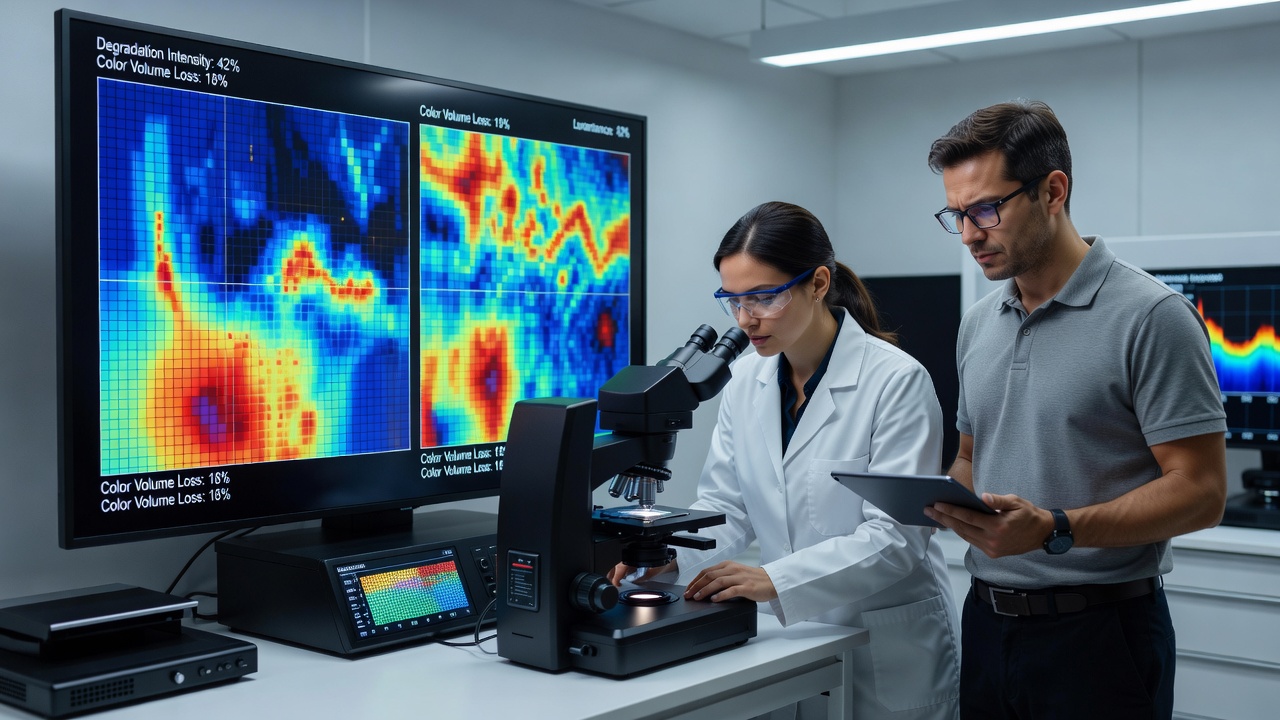
Thermal buildup from continuous high-frame-rate rendering compounds the issue because elevated operating temperatures facilitate ion migration within the quantum dot matrix, and evidence collected from controlled chamber experiments demonstrates that panels kept below 40 degrees Celsius retain color volume longer than those reaching 55 degrees Celsius during extended loads.
Impact on Color Volume Retention
Color volume represents the three-dimensional space of achievable colors at varying brightness levels, and degradation shrinks this space primarily in the mid-to-high luminance ranges where HDR content operates most of the time; quantitative measurements indicate losses of 8 to 15 percent in effective volume after 4000 hours of mixed HDR and SDR use, with the most pronounced reductions occurring in saturated reds and greens that rely heavily on quantum dot emission.
Desktop users engaged in long asset-heavy sessions notice these changes through gradual desaturation of bright elements rather than outright failure, and calibration software can partially compensate early on yet cannot restore lost quantum efficiency once particle-level damage accumulates.
Contributing Factors in High-Refresh Desktop Setups
Refresh rate itself does not directly degrade quantum dots, yet the increased pixel drive frequency required for stable 144Hz-plus operation generates additional electrical stress that interacts with bright HDR frames, and data collected across multiple panel generations shows this interaction becomes relevant when sessions extend beyond six or eight hours daily with content that maintains high average picture levels.
Backlight dimming algorithms and local dimming zone counts also play roles because uneven illumination patterns can concentrate photon exposure in certain display zones, accelerating localized degradation while other areas remain relatively protected.
Research Insights and Measurement Approaches
Standardized testing protocols from organizations such as the National Institute of Standards and Technology outline procedures for tracking quantum dot luminance decay and color shift under controlled HDR cycles, while additional work from European research consortia provides comparative data across different quantum dot material formulations used in current monitor lines.
Those tracking these metrics through June 2026 continue to refine predictive models that correlate total HDR exposure hours with expected color volume retention percentages, enabling manufacturers to adjust layer thickness or protective coatings in upcoming revisions.
Conclusion
Quantum dot layer degradation under prolonged HDR exposure follows identifiable patterns that progressively reduce color volume retention in high-refresh desktop displays, and the effects become most apparent during extended asset-heavy sessions where bright, saturated content dominates; continued monitoring and material refinements remain central to preserving performance as usage patterns evolve.