Error Correction Mechanisms in High-Speed DRAM Modules During Intensive Gaming Memory Access Patterns
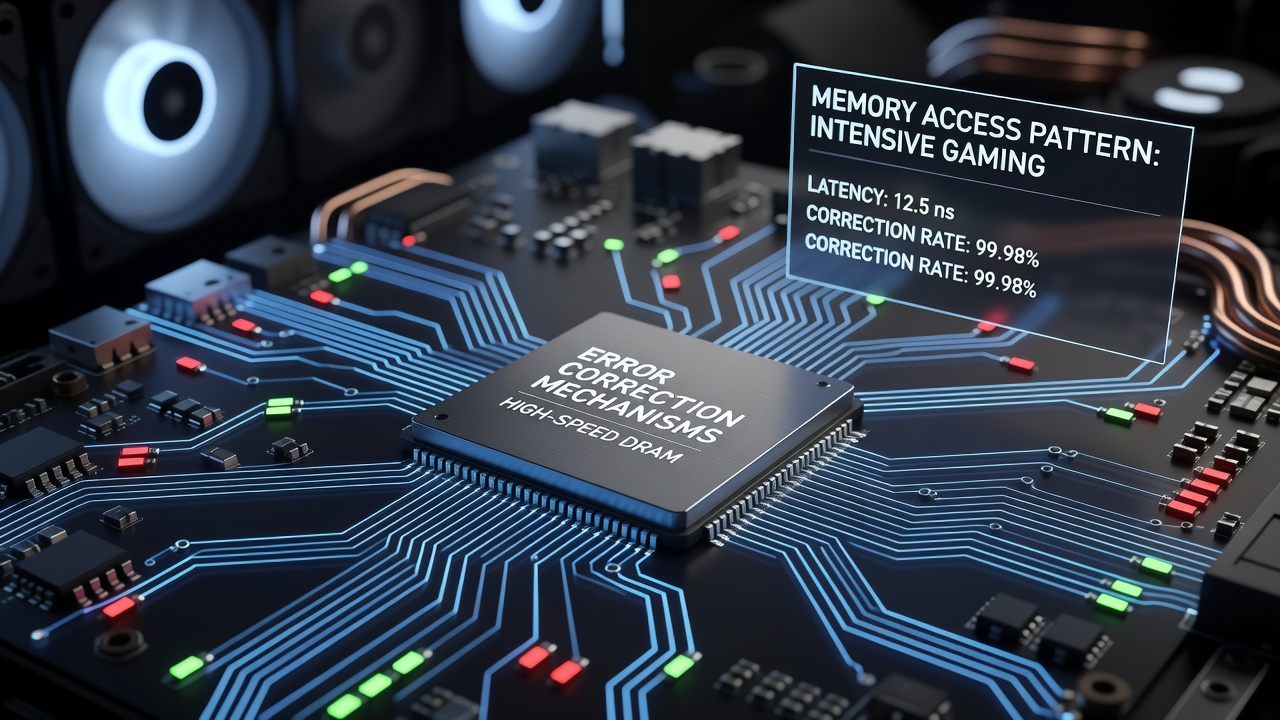
High-speed DRAM modules handle the constant data demands of modern games through rapid read and write cycles that often reach several gigatransfers per second, and error correction mechanisms step in to maintain data integrity when electrical noise or particle strikes introduce bit flips during these bursts. Gaming workloads create irregular access patterns with frequent jumps between memory addresses for textures, shaders, and physics calculations, which increases the chance of transient errors compared to steady sequential loads.
Core Principles of Error Detection and Correction in DRAM
DRAM cells store bits as electrical charges in capacitors that leak over time, so refresh operations combine with error-correcting codes to catch single-bit mistakes before they propagate through a game's rendering pipeline. Error-correcting code schemes such as SECDED add parity bits to each data word, allowing the memory controller to identify and fix isolated errors while flagging double-bit problems that require system-level intervention. Manufacturers embed these features directly into DDR5 modules through on-die ECC circuits that operate independently of the host processor, reducing latency penalties during peak gaming sessions.
Studies from research institutions in the European Union have tracked how row hammer effects, where repeated access to one row disturbs neighboring cells, become more pronounced under the randomized memory patterns typical in open-world titles. Mitigation techniques like targeted row refresh now integrate with ECC logic to refresh vulnerable rows proactively, and data from controller logs shows these combined approaches cut uncorrectable error rates by measurable margins in sustained loads.
Performance Under Gaming-Specific Access Patterns
Intensive gaming sessions produce memory traffic dominated by small, scattered transactions rather than large contiguous blocks, and this profile stresses ECC engines because each transaction must undergo syndrome calculation without stalling the memory bus. High-bandwidth interfaces in modules rated above 6000 MT/s incorporate additional pipeline stages that overlap error checking with data transfer, keeping frame delivery consistent even when multiple CPU and GPU threads contend for bandwidth. Observers note that modules equipped with robust on-die correction maintain stable operation longer during extended asset streaming sequences compared to non-ECC variants under identical voltage and temperature conditions.
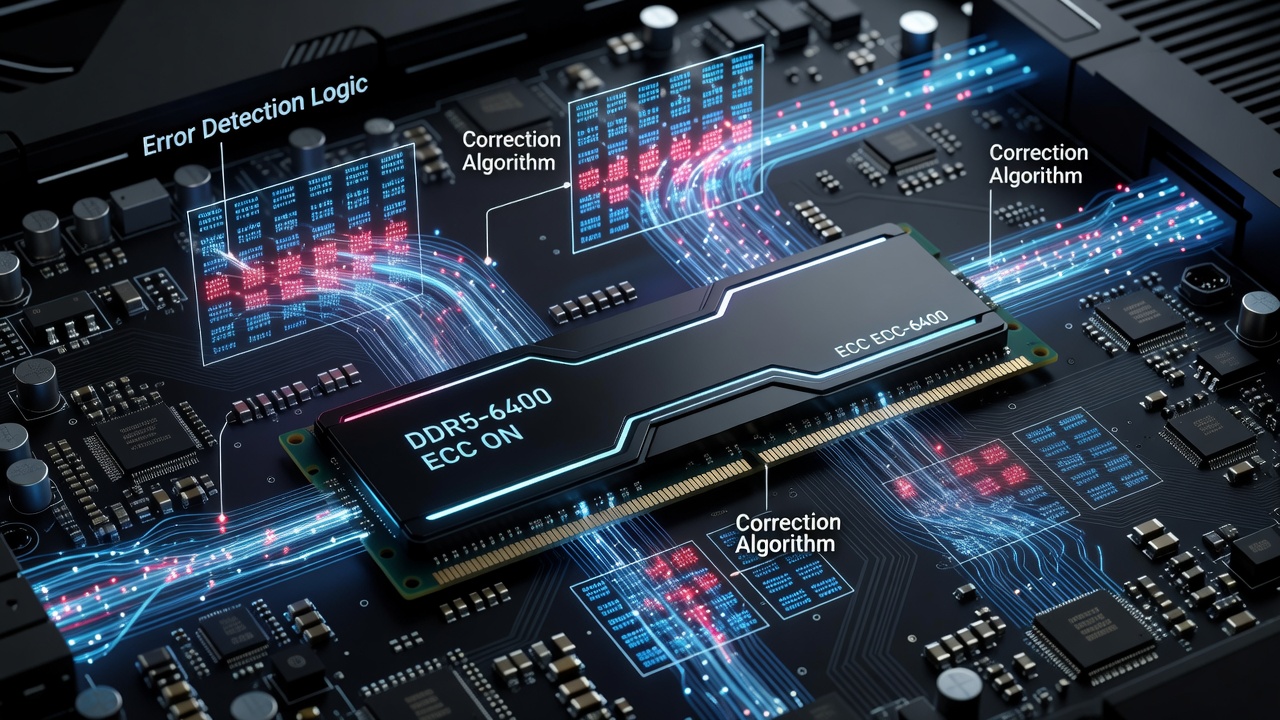
Thermal variations inside compact chassis further influence error rates because elevated temperatures accelerate charge leakage, yet modern DRAM designs pair thermal sensors with adaptive refresh intervals that work alongside ECC to compensate automatically. Reports compiled by standards organizations indicate that modules tested at 1.35 V and 85 °C still deliver correctable error recovery rates above 99 percent for single-bit faults across thousands of hours of simulated gaming traffic.
Recent Developments and June 2026 Context
By June 2026, updated JEDEC specifications have expanded support for enhanced ECC variants that accommodate higher density dies while preserving signal integrity at transfer rates approaching 8000 MT/s. These revisions incorporate improved scrubbing algorithms that periodically scan entire memory arrays during idle windows between game levels, clearing accumulated correctable errors before they accumulate into multi-bit failures. Hardware vendors have begun shipping modules that log error statistics through sideband interfaces, allowing system software to adjust memory timings dynamically when patterns indicate rising soft error activity.
Academic analyses conducted at Canadian universities have modeled how gaming workloads with heavy procedural generation create bursty access sequences that concentrate errors in specific address ranges, prompting the adoption of address interleaving combined with ECC to distribute risk more evenly. The resulting configurations demonstrate lower uncorrectable error incidence during long play sessions without requiring changes to game code or drivers.
Integration with System-Level Reliability Features
Memory controllers in current platforms coordinate DRAM ECC with higher-level protections such as link-level CRC on the memory bus, creating layered defenses that catch errors missed at the chip level. When a gaming system encounters a correctable error during a critical texture load, the controller signals a retry at the hardware level before the GPU pipeline stalls, preserving frame pacing. Industry data collected across multiple regions shows these layered mechanisms reduce visible artifacts in real-time rendering by intercepting faults that would otherwise surface as corrupted pixels or geometry glitches.
Conclusion
Error correction mechanisms in high-speed DRAM continue to evolve in response to the demanding access patterns generated by contemporary games, relying on on-die ECC, adaptive refresh, and integrated logging to sustain data accuracy. Continued refinement of these techniques, aligned with updated standards through 2026, supports reliable operation across varied hardware configurations and workload intensities.