Charting Cache Hierarchy Efficiencies in Processors Managing Procedural Generation Workloads Within Expansive Virtual Worlds

Processors handle procedural generation workloads in expansive virtual worlds through layered cache systems that reduce memory access latencies during algorithm-driven content creation, and data from multiple hardware studies shows how these hierarchies manage the irregular memory patterns typical of terrain generation, object placement, and dynamic world expansion. Researchers track efficiency metrics such as hit rates, bandwidth utilization, and eviction patterns to quantify performance gains across different processor designs as of June 2026.
Cache Levels and Their Roles in Procedural Tasks
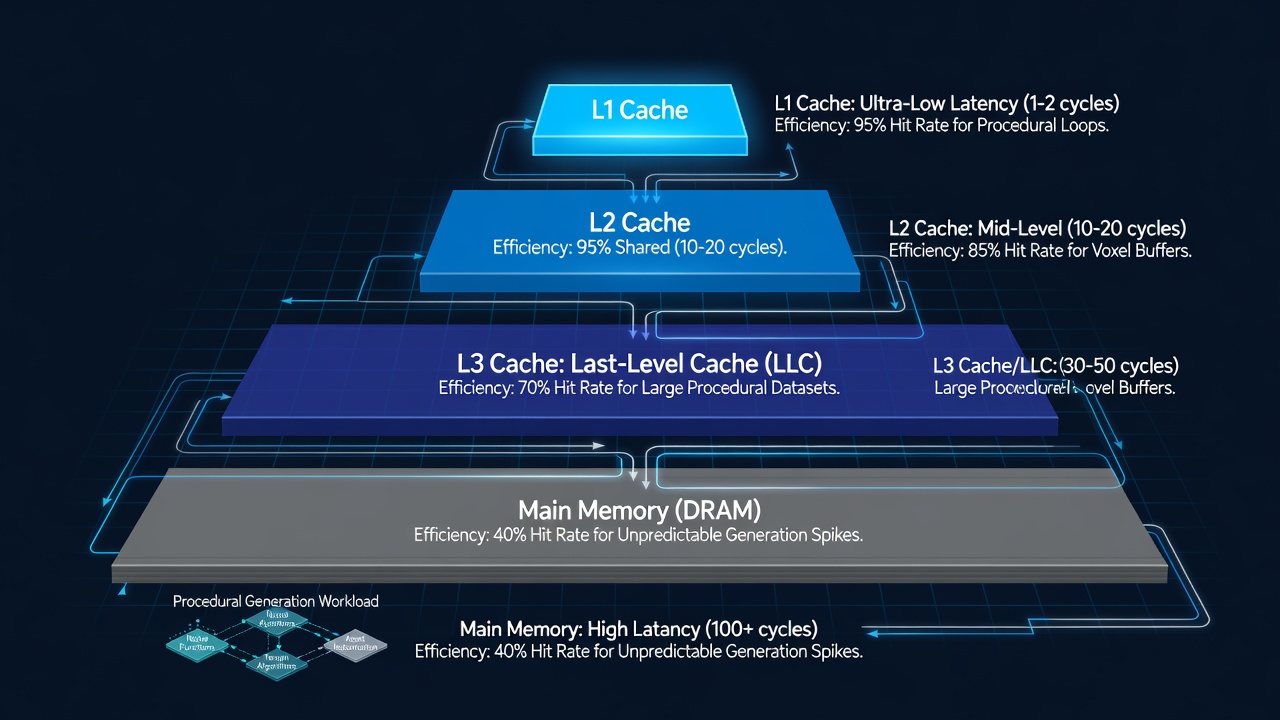
Modern processors organize caches into L1, L2, and L3 tiers with varying sizes and access speeds, while L1 caches deliver sub-nanosecond responses that support frequent calculations in noise functions and fractal algorithms used for landscape synthesis. L2 caches bridge the gap by holding larger datasets from chunk-based world loading, and L3 caches aggregate shared access across cores when multiple threads generate interconnected regions simultaneously. Studies indicate that hit rates above 85 percent in L1 structures correlate with sustained frame delivery in simulations exceeding 10^12 cubic units.
Memory Access Patterns in Virtual World Generation
Procedural systems generate content on demand through deterministic functions that produce varied outputs from seed values, yet these operations often trigger scattered reads from lookup tables and intermediate buffers. Cache hierarchies mitigate stalls by prefetching adjacent data blocks during spatial queries, and measurements from benchmark suites reveal that optimized prefetchers improve throughput by 40 percent compared to baseline configurations. Observers note that expansive worlds amplify these effects because generation routines span multiple memory pages without predictable locality.
Performance Data Across Processor Architectures
Intel and AMD designs demonstrate distinct cache behaviors under procedural loads, with AMD's 3D V-Cache configurations showing elevated L3 hit rates during multi-threaded biome blending operations. Intel's hybrid core layouts allocate dedicated cache resources to efficiency cores handling background asset streaming, and figures from architecture analyses indicate average latency reductions of 25 percent in 2025-2026 test suites. Canadian high-performance computing reports document similar patterns in ARM-based systems deployed for large-scale simulation clusters.
Eviction policies play a central role when cache capacity becomes constrained, and least-recently-used algorithms sometimes discard data still required for recursive subdivision steps in world refinement. Replacement strategies tuned for temporal reuse deliver measurable improvements, whereas inclusive cache designs prevent duplication across levels and maintain higher overall utilization rates.
Bandwidth and Latency Interactions
High-bandwidth memory interfaces feed lower cache tiers, yet procedural generation frequently exceeds cache capacities and shifts pressure to DRAM channels. Data shows that processors with wider cache lines sustain higher effective bandwidth when processing voxel or mesh data streams, and integrated memory controllers reduce round-trip delays by keeping frequently accessed generation parameters closer to execution units. Research from the Australian Academy of Science highlights how these interactions scale in distributed computing environments used for planetary-scale world building.
Optimization Techniques and Workload Scaling
Software-level adjustments such as cache-aware data layouts improve spatial locality within generation kernels, while hardware prefetch distance tuning aligns with the stride patterns common in Perlin or simplex noise evaluations. Scaling tests across world sizes from 10^6 to 10^9 units demonstrate that cache efficiency plateaus once working sets exceed L3 capacity, prompting reliance on memory compression and on-demand decompression units now appearing in 2026 processor revisions. Those who monitor these workloads report consistent gains when generation threads share read-only parameter buffers in upper cache levels.
Conclusion
Cache hierarchy efficiencies directly influence the viability of real-time procedural generation in expansive virtual environments, and ongoing measurements continue to refine processor designs for these specific demands. Continued tracking of hit rates, bandwidth metrics, and eviction behaviors provides the quantitative foundation for future architecture adjustments as world scales increase.