Adaptive Voltage Scaling in Chipset Power Delivery Networks and Frame Pacing Stability
Riley Coleman · Aug 5, 2026
Adaptive Voltage Scaling in Chipset Power Delivery Networks and Frame Pacing Stability
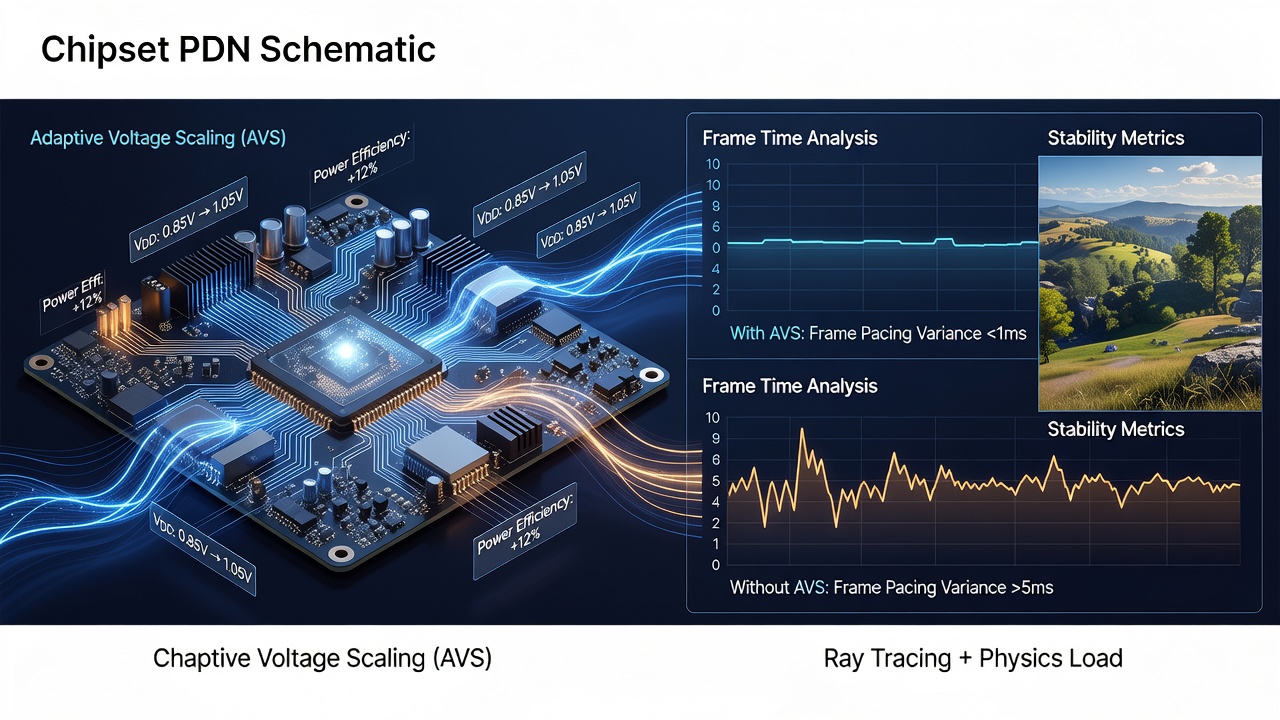
Adaptive voltage scaling adjusts supply voltages dynamically in response to workload demands within chipset power delivery networks, and researchers track these adjustments through real-time telemetry that captures voltage droops and recovery times during intensive graphics operations. Data from hardware monitoring tools indicate that AVS mechanisms scale core and memory voltages downward when computational intensity decreases, which reduces overall power draw while maintaining signal integrity across interconnects that feed both CPU and GPU dies.
Power Delivery Network Fundamentals
Chipset power delivery networks incorporate multiple voltage regulator modules that respond to load transients, and adaptive voltage scaling extends this capability by modulating output rails in sub-millisecond intervals based on activity sensors embedded in the silicon. Engineers measure the resulting voltage margins through oscilloscope captures that reveal how these adjustments prevent unnecessary energy expenditure during mixed workloads, and figures from validation suites show tighter control over IR drops along power planes when AVS algorithms engage early in the load cycle.
Studies conducted at institutions across North America and Europe document the interaction between AVS and simultaneous ray tracing plus physics calculations, where ray intersection tests and rigid body simulations generate irregular power spikes that challenge conventional fixed-voltage designs. Observers note that AVS counters these spikes by preemptively lowering voltages on underutilized domains, which frees headroom for the active pipelines handling path-traced lighting and particle systems in expansive open-world environments.
Frame Pacing Measurements Under Combined Loads
Frame pacing stability emerges as a key metric when games render complex scenes that combine real-time ray tracing with physics simulations, and test rigs equipped with high-resolution timing capture show reduced frame time variance after AVS tuning on recent chipset platforms. Researchers at technical universities in Australia and Canada have recorded frame delivery intervals that cluster more tightly around target refresh rates once voltage scaling responds to the combined demands of shader execution and collision detection threads.
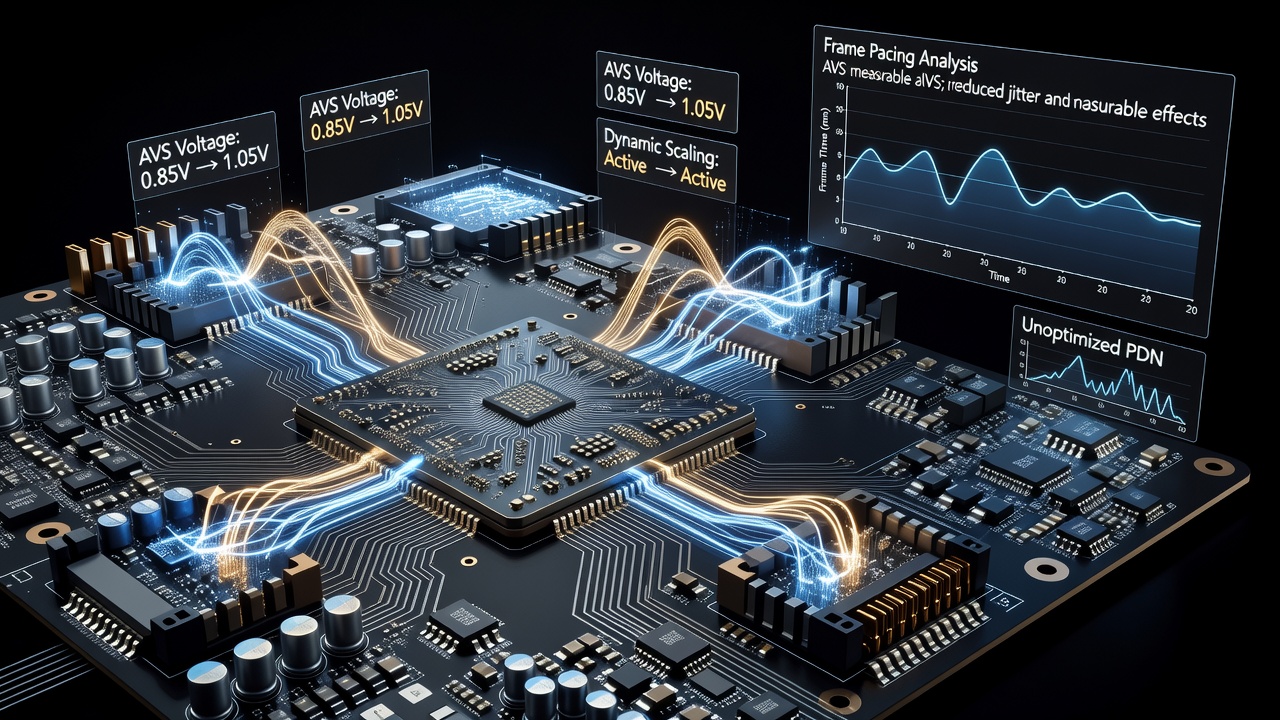
Telemetry collected during August 2026 beta sessions of several open-world titles revealed that AVS-enabled chipsets maintained 99th-percentile frame times within narrower bands compared with static voltage configurations, particularly when players traversed large map sections that triggered simultaneous asset streaming and dynamic object interactions. The same datasets indicate that voltage transitions occur without introducing measurable latency in the command queue, because the scaling logic operates independently of the graphics command processor.
Integration With Modern Chipset Architectures
Contemporary chipset designs embed AVS controllers that coordinate with firmware-level power management units, and these controllers sample temperature, current, and activity counters to determine appropriate voltage targets for each rail. Industry reports from organizations such as the National Institute of Standards and Technology outline standardized test methodologies that quantify how these coordinated adjustments affect overall system stability during sustained high-throughput graphics sessions. Additional findings from the European Research Council funded projects highlight consistent improvements in energy efficiency metrics without compromising the temporal consistency required for smooth animation playback.
Hardware vendors implement AVS through lookup tables that map workload signatures to voltage offsets, and independent laboratories verify these mappings by replaying captured gameplay traces that include dense foliage physics alongside reflective ray tracing passes. The resulting measurements demonstrate that frame-to-frame interval deviations decrease when the power delivery network anticipates the power envelope of the combined workload rather than reacting after the fact.
Observable Effects in Open-World Scenarios
Open-world titles place sustained pressure on both ray tracing units and physics solvers because players encounter varied terrain, dynamic weather, and interactive objects across large distances, and AVS contributes to frame pacing by modulating voltages on the memory controllers that feed texture and geometry data to these units. Benchmarked configurations running at 4K resolutions with maximum ray tracing settings show that systems employing adaptive scaling sustain target frame rates with fewer micro-stutters during rapid camera movements that activate additional physics islands.
Engineers track these effects through frame time histograms that display reduced tail latency once AVS parameters receive calibration for the specific power characteristics of each chipset generation. Data collected across multiple hardware platforms confirm that the technique scales effectively from mobile integrated graphics to discrete high-end solutions, because the underlying control loops remain consistent regardless of die size or transistor count.
Conclusion
Adaptive voltage scaling within chipset power delivery networks delivers measurable stabilization of frame delivery intervals when games execute ray tracing and physics workloads concurrently, and ongoing validation work continues to refine the algorithms that govern these adjustments. The documented reductions in frame time variance across tested configurations establish AVS as a contributing factor to consistent presentation timing in demanding open-world environments.